Several species of scarab beetles are pests of field crops in the northern grains region.
Black sunflower scarab (Pseudoheteronyx basicollis)
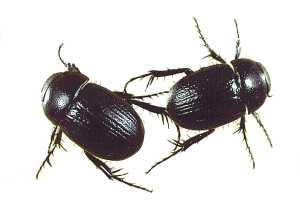 A pest in Queensland sunflowers. Parthenium weed is a favoured host but the larvae can develop on the roots of numerous grasses and weeds. One generation occurs per year, with adults damaging sunflower crops in summer.
Larvae are creamy white C-shaped grubs with wrinkly bodies. They grow up to 25mm long with a grey rear end, brown head capsule. Adult beetles are 13mm long, shiny and black.
Larvae feed on taproots causing wilting and death of plants up to 400mm high. Damage is most prevalent where sunflowers follow wheat, sorghum or grass pasture. Adult beetles feed on foliage, often in a line across the field.
Check in the soil by digging and sieving for the presence of larvae prior to planting, and at all stages for adults. Particularly look for feeding beetles just before sunset. Four beetles per square metre can cause severe losses to young seedlings.
Chemicals are registered but are of limited effectiveness. No effective natural enemies have been identified. Removal of the host parthenium weed is advised. Damage is most prevalent where sunflowers follow wheat, sorghum or grass pasture.
Peanut scarab (Heteronyx spp.)
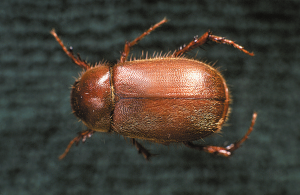 Peanut scarab is a pest of peanuts, particularly in the South Burnett, Atherton Tableland and the Clifton/Nobby region of the Darling Downs. It also occurs in pasture.
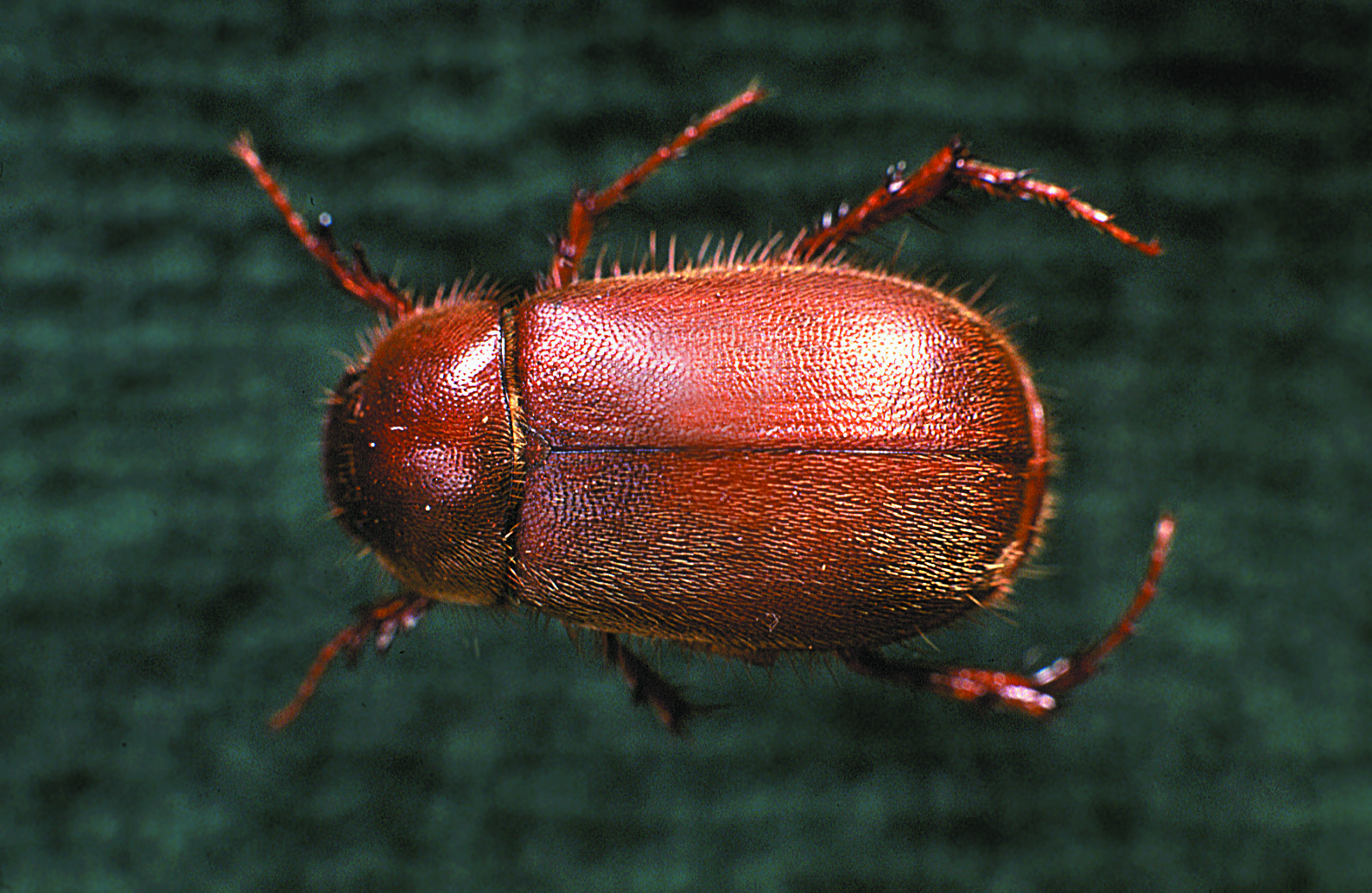
Adult beetles are 7 mm long, oval and uniformly brown (much paler than black sunflower scarabs). They emerge from the soil in the late spring and early summer after heavy storm rains to feed on vegetation, then return to the soil to lay eggs.
Larvae (whitegrubs) are up to 25 mm long, creamy-white with a dark head and are bent in a C-shape. Young larvae feed on soil humus and plant roots. Older larvae attack the shells and kernels of peanuts, reducing yield and quality. Early planted crops tend to become more infested than later planted crops.
The one-year life cycle is adapted to peanuts. Beetles lay their eggs under peanut seedlings. Larvae overwinter in the soil and pupate in the spring.
Young larvae feed on the roots of peanuts while older larvae attack peanut shells and kernels. Beetles feed on seedling leaves. Heavily infested crops may suffer over 30% yield loss. Damaged pods are prone to invasion by species of Aspergillus fungi, which can produce the highly carcinogenic aflatoxin.
Difficult to monitor prior to planting. Presence of small larvae and adults underneath seedling crops is an indicator of likely later crop damage.
Control is not feasible once a crop is infested with larvae. If damage is anticipated, apply soil-incorporated pesticides at planting to control egg-laying adults and newly hatched larvae. A granular pesticide is registered for peanut scarabs in peanuts and gives cost-effective control. Avoid successive peanut crops and eliminate peanut volunteers from rotation crops.
Peanut scarab larvae are sometimes parasitised by wasps but parasitism levels are usually low (less than 1%). Larvae are sometimes killed by the Cordiceps fungus, but such infections are rare.
African black beetle (Heteronychus arator)
A major pest in southern Australian maize, it has a widespread distribution in winter rainfall areas. It is present but not recorded as a pest in south-eastern Queensland. Outbreaks are usually sporadic during spring and summer, but may occur several years in succession in the same location. Dry springs and summers favour build-up in numbers.
Most damage is caused by adults feeding on the underground stems of young plants, often killing growing points so that the central shoots wither and the plants become dead-hearted. Older plants usually survive, but remain weak and liable to lodging.
Beetles may be present in the soil prior to planting, especially if the land has recently grown pasture, or may fly in after planting. Beetles are often found near the base of damaged plants. Damaged young plants usually produce suckers.
More than 10 beetles per square metre may result in significant crop damage, but control may be warranted with densities of five per square metre or less (see the APVMA database for current registrations).
Newly hatched larvae are about 5 mm long with six legs, white bodies and pale brown heads. Fully grown larvae are 25-30 mm in length with a creamy-white body and light brown head. The rear end has a dark grey tinge, when resting the grubs curl into a C-shape. The adult beetle is a rich chestnut colour when newly emerged, but changes to a shiny black, stout bodied beetle approximately 10-15mm long.
Avoid planting into recently cultivated pasture that may contain adults. Remove grass and weeds from headlands to reduce potential reservoirs. Beetles crawling into a crop can be stopped by cutting a deep furrow with a vertical side nearest the crop. Beetles that concentrate in the furrow can be killed. Delay sowing until November-December when most beetles have died, but before the new generation of beetles emerges in January, to avoid peak beetle activity.
For images of African black beetle, see the PestNote at Cesar Australia.