
Since 2022 an insecticide resistance surveillance program for fall armyworm (FAW) has been conducted annually by NSWDPIRD in collaboration with QDPI entomologists, with 1680 samples tested during 2025-26. The program is critical in FAW management because it signals changes in susceptibility trends and provides an early warning to crop managers about potential resistance outbreaks, as well as giving practical insights which support grain growers to optimise their spray programs.
In 2025, the Horticulture Innovation (HI) project ‘FAW Area Wide Management Project’ (VG22006), was boosted with a variation to develop an Insecticide Resistance Management Strategy (IRMS) for the vegetable industry. A critical step in developing the IRMS is the accumulation of baseline susceptibility data in FAW populations from across horticultural production regions and has effectively increased surveillance coverage to include horticultural regions of far north Queensland, Bundaberg in central Queensland, the Lockyer Valley in southern Queensland, northern NSW and the Sydney Basin as well as northern WA and NT.
The additional investment from HI complements and strengthens existing resistance monitoring in the grains industry supported by the GRDC project ‘Targeted resistance management for corn earworm and FAW in the northern region’ (DPI2507-002RTX). This cross-industry program of surveillance ensures that both horticultural and grains producers benefit from a unified and pre-emptive approach to resistance stewardship.
Testing methods
The program utilises F2 screening for detecting resistance to key selective insecticides registered for FAW control including spinetoram (Group 5), emamectin benzoate (Group 6), indoxacarb (Group 22A), and chlorantraniliprole (Group 28). Crops sampled included sorghum, maize and sweet corn.
The capacity for early detection of resistance combined with adoption of best management practices will be key to reducing resistance risk in grains, horticulture and other industries impacted by FAW.
Chemical mode-of-action groups tested:
- GROUP 5 Spinetoram (e.g. Success Neo®, Entrust®)
- GROUP 6 Emamectin benzoate (e.g. Affirm®, Proclaim Opti®)
- GROUP 22A Indoxacarb (e.g. Steward®, Avatar®)
- GROUP 28 Chlorantraniliprole (e.g. Vanticor®, Coragen®)
From a total of 1680 FAW alleles tested for resistance in samples collected from across grains and horticultural crops in 2025-26 (see Table 1 for collection sites), no positive cases of resistance were detected. These results confirm there was no change in susceptibility to chlorantraniliprole, emamectin benzoate, spinetoram or indoxacarb in the populations tested indicating that these insecticides should remain effective for management of FAW in the coming season if used according to label instructions.
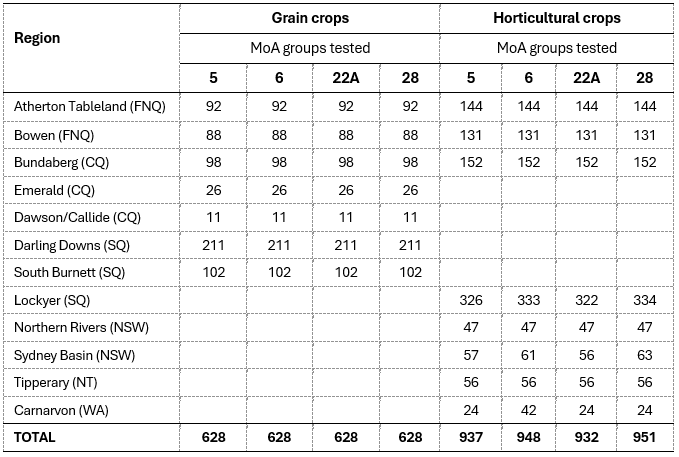
Table 1. Numbers of FAW tested for resistance in 2025-26 (current on August 31, 2026)
Implications for fall armyworm management
Testing data from the past season indicated that genes for resistance to chlorantraniliprole, emamectin benzoate, spinetoram and indoxacarb remain extremely low in FAW, confirming results from previous testing programs (2021 to 2025) which showed the frequency of resistance genes in eastern Australian FAW populations is very rare. Although this is a positive sign that selective insecticides will continue to provide effective control of FAW in the coming season, it will be important for crop managers to be mindful of the potential for FAW to develop resistance due to the high rates of insecticide use across a range of cropping systems.
Widespread overuse of Group 28 insecticides elsewhere in the world has resulted in increased resistance to this MoA group and the recent emergence of resistance to these insecticides in a related species Spodoptera litura (cluster caterpillar) has led to reduced efficacy in this pest in horticultural regions of northwest WA. Therefore, there is an urgent need for the horticultural industry to collectively avoid practices that increase resistance risk in FAW by adopting the measures outlined below.
To reduce the risk of lost productivity due to resistance, growers are urged to comply with key recommendations to minimise selection pressure on chemical mode-of-action group across consecutive generations of fall armyworm.
Using a broad range of IPM options to specifically target FAW and promote natural enemies in crops will reduce over-reliance on any one chemical group. Following these recommendations and complying with label instructions will minimise the risk of spray failures and support sustainable management of FAW.
General principles to minimise resistance development:
- Comply with all directions on product labels – DO NOT cut rates or exceed the recommended applications per crop per season.
- Avoid repeated use of insecticides from the same chemical group. Do not re-spray with that group again in the same season.
- Monitor regularly using appropriate sampling techniques.
- Correctly identify the pest to ensure the most effective insecticide and rate is used.
- Monitor beneficial populations to determine if chemical control of the pest is warranted.
- Use economic thresholds, if available, when making spray decisions.
- Avoid prophylactic sprays.
- Use target-specific ‘soft’ chemicals where possible, rather than broad-spectrum pesticides.
- Consider the impact on all species present when applying insecticide sprays; be aware of potential implications for Helicoverpa resistance when managing FAW.
- Ensure spray rigs are calibrated properly and sprays achieve effective coverage.
- Monitor post-treatment for evidence of loss of field efficacy and report field failures.