Keeping an eye on local conditions and weather forecasts is part of everyday crop management. Ensuring conditions are optimal for establishment and growth and identifying potential risks to physiological development help ensure the crop achieves its yield potential.
Weather can also play a major role in insect abundance and distribution. Sometimes the effect is indirect, such as favourable conditions increasing food sources, however temperature, humidity, light levels, rainfall and wind can all directly influence pest/beneficial occurrence, development and behaviour, as well as affect the success (or otherwise) of many pest management options.
On this page:
- Impact on occurrence
- Impact on development
- Impact on behaviour
- Impact on pest management
- Insect folklore
- Further information
Impact on occurrence
Migratory pests
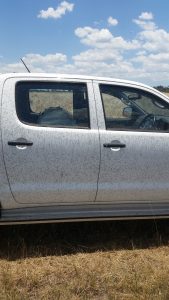
Rutherglen bugs can occur in large numbers
Favourable weather conditions in distant breeding areas combined with prevailing winds can result in large influxes of migratory pests in some years. Some common examples or seasonal migrations include helicoverpa, Rutherglen bug, mirids, fall armyworm, and locusts. Extreme storms can help insects migrate into new habitats, although high wind speeds are likely to reduce the overall number of airbourne insects. Sometimes the weather can trigger plagues of native insects not usually considered crop pests (see Beatsheet articles on Antictenia at Kingaroy and Oulema on millet.
Warm sunny conditions can result in the movement of small pests (such as winged aphids) in convection layers. Local migrations of aphids and other small pests often result in an ‘edge effect’ where the arriving insects settle at the closest field edge.
In-field pests and beneficials
Wind and rainfall events can assist or restrict arthropod movement locally within or between fields; occurrence within a field can be impacted by both microclimate and weather events. Particular weather conditions can favour or disadvantage different species, including affecting their level of activity or preferred location in the plant canopy. Sampling protocols need to be flexible enough to allow for these differences.
Excess or intense rainfall can knock pests off plants (aphid populations commonly reduce after rainfall), or trigger pest emergence from the pupal stage (e.g. Monolepta beetle swarms).
Adverse conditions, particularly extreme temperatures or unfavourable humidity, can physiologically stress the crop, and in some cases produce symptoms similar to some forms of insect damage (e.g. shedding of cotton squares due to high temperatures or low radiation can look like mirid damage). Awareness of the potential for physiological damage from environmental factors can prevent unnecessary sprays.
Environmental stress can also influence the likelihood of encountering particular species in the field, with some pests (e.g. soybean moth) attracted to stressed plants.
Impact on development
Insect development is highly temperature dependant, and many insect growth models, including DARABUG use heat units such as degree days or equivalent to calculate development rates.
Unusually hot conditions may allow additional generations of pests in a season, but this may be mitigated to some extent by faster development of beneficials (if present). Similarly, cooler than expected seasonal conditions can slow the rate of development of both pests and beneficials.
Humidity can also have a market impact on insect survival. Although many insects get sufficient water from the vegetation they eat, desiccation is more likely under low humidity, particularly of eggs and young insects. High humidity is likely to increase the likelihood of beneficial pathogens both surviving and spreading. Fungal pathogens are favoured by damp conditions, and the spread of vial pathogens is improved in rainy weather.
Impact on behaviour
Temperature heavily influences insect activity. Insects are cold-blooded—many species have a preferred temperate range and are inactive below a particular temperature, so the relative activity of species will change at different times of the day. See the Beatsheet article: Hot weather heats up pest activity.
Avoid sampling in hot conditions if possible, as most insects move faster and winged or highly mobile species such as mirids are more likely to move away before they can be counted. Temperature extremes can cause insect mortality.
Feeding behaviour is also often linked to temperature. Many insects will eat less (and potentially cause less damage) as the weather cools. Uptake of ingested pesticides is therefore lower, and the pest may not consume a lethal dosage of products that degrade quickly.
The lowered atmospheric pressures that herald a rain event may discourage mating in some species or change other actions such as pheromone release or oviposition behaviour.
Insect diapause (a halting of developmental growth) is usually triggered by environmental conditions, including temperature and day length.
Plant stress caused by environmental conditions can impact on insect feeding behaviour or feeding preferences (e.g. as leaves become less palatable, pests such as helicoverpa may move to growing points or reproductive structures).
While research into the influence of lunar cycles on insect behaviour is mixed, with some studies reporting impacts on adult emergence and migration, it should be noted that if using light traps as part of a pest management program, counts should be adjusted to account for light levels (as the level of moonlight increases, the effectiveness of the trap in attracting insects to the artificial light source usually decreases).
Impact on pest management
Weather is a key consideration for management actions, particularly spraying. High temperatures and low humidity can reduce droplet size, increasing the risk of drift. Application of certain pesticides under some weather conditions (such as inversions) can be illegal in some cases. Be aware of local conditions, including wind speed and direction, and always check the label for weather-related restrictions. See the Beatsheet article on Controlling summer pulse pests in wet weather.
Rainfall can have an impact on field access, and rain post-spraying may reduce the effectiveness of the product, particularly if it is not systemic.
Insect folklore
In the days before weather stations and instant apps, many natural sources were used to help predict the weather. From ants moving nests to cicadas chirping, insect activity and sounds have long been promoted as weather indicators, often in rhyme:
‘If ants their walls do frequent build, rain from the clouds will be spilled’,
‘If bees stay at home, rain will soon come; If they fly away, fine will be the day’, and
‘When ladybugs swarm, expect a day that’s warm’.
There’s been a number of studies on the effects of temperature on the chirp-rate of grasshoppers and crickets, and even a formula published (known as Dolbear’s law) where the temperature (in degrees Celsius) can be estimated by counting the number of cricket chirps counted in 8 seconds and adding 5.
More information
- Weather for Pesticide spraying (Bureau of Meteorology brochure)
- Spray application manual (GRDC)
- A network of moth pheromone traps provides an indication of helicoverpa and fall armyworm flights.
- The federal Department of Agriculture, Fisheries and Forestry provides a locust bulletin predicting the potential for an outbreak in the following three months.
Further reading
- Burt, P (2002) Weather and pests. Weather 57:180-184
- Dolbear, Amos (1897). “The cricket as a thermometer”. The American Naturalist. 31 (371): 970–971.
- Inwards, R (1869) Weather lore: a collection of proverbs, sayings and rules concerning the weather. W. Tweedie, London.
- Owens, B (2013) Amorous insects predict the weather, Nature (October 2, 2013)
- Palumbo, J (2011) Weather and insects. Yuma Agricultural Centre Veg IPM Update, 2(6): March 23, 2011