The term ‘loopers’ covers a range of caterpillar species that have only 1-2 pairs of abdominal prolegs (helicoverpa have 4) and therefore tend to walk by pulling the rear of the body towards the head and forming a loop before extending the front of the body forwards.
Caterpillar movement: ‘slinking’ (helicoverpa) versus ‘looping’ (looper):
In pulse crops, loopers are mainly of concern in soybean, mungbean, navy bean, and adzuki bean, although they may also occur in pigeonpea and cowpea. Other hosts include sunflowers, cottton, canola, lupins and pasture species.
Looper eggs come in a range of sizes and shapes, but often a pale yellow-green. They hatch in 3-6 days. There are six larval stages. Larvae can reach 50 mm in length and are often tapered at the head. They can be green or brown, and may have white and/or dark stripes. Small larvae tend to feed on only one side of the leaf when small, leaving translucent ‘feeding windows’. As larvae develop, they chew holes in the leaf, and then feed from the leaf margin. Larvae take 2-3 weeks to develop before pupating under leaves in a cocoon veiled in loose silk.
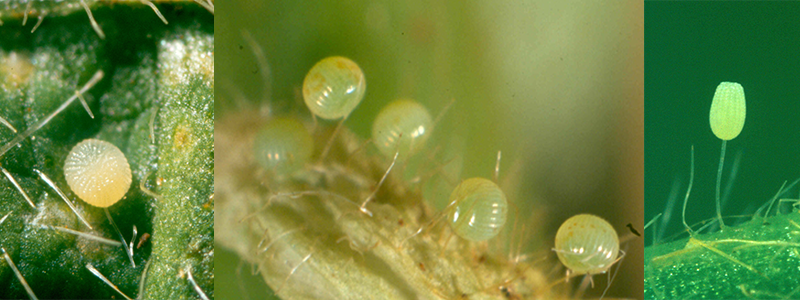
Examples of looper eggs. From left: soybean looper, bean looper, twig caterpillar
Types of loopers
Soybean looper (Thysanoplusia orichalea) are primarily foliage feeders in soybeans, but will attack the flowers and developing pods in azuki beans, mungbeans and navy beans. Larval colour can vary considerably. Very small larvae are green all over but medium larvae usually have prominent dark and white striping. Large larvae (up to 45mm in length) are usually green with thin white stripes. The moth has a large, bright gold patch on the forewings.
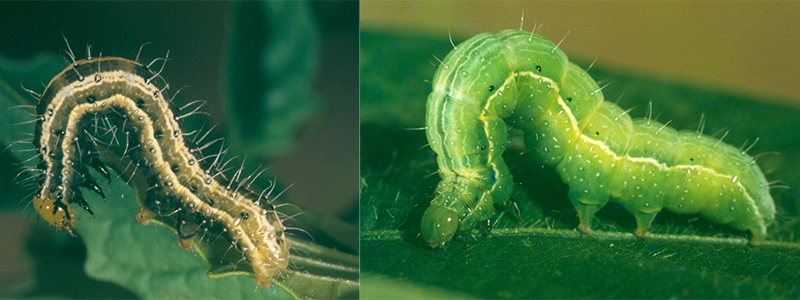
Soybean looper larvae: medium (left) and large
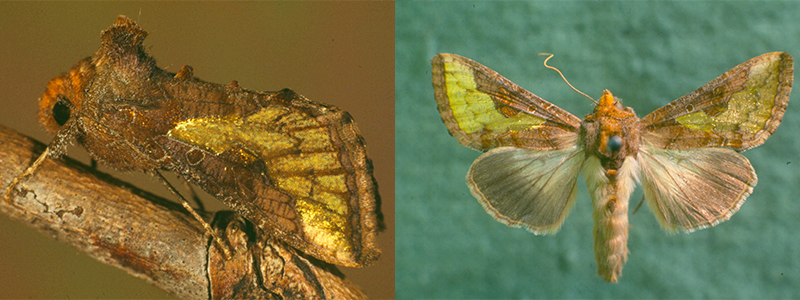
Soybean looper moth viewed from the side (at rest) and a preserved specimen with the wings spread.
Castor oil looper (Achaea janata) larvae are brightly patterned and come in light and dark variants, with two conspicuous black spots on the back behind the front legs. They are large (up to 60mm) with 3 pairs of abdominal prolegs. Moth forewings are a mottled dark brown with darker lines, and the hindwings have a white band across the wing and three evenly spaced white blotches along the outer margin of the wing. Castor oil loopers can be a pest of soybeans but rarely occur in damaging numbers.
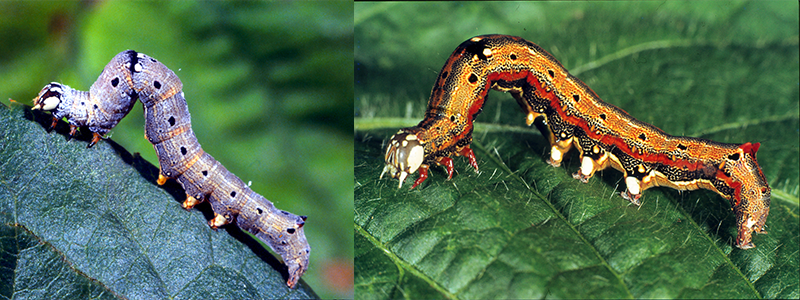
Large caster oil looper larvae: purple (left) and orange variants
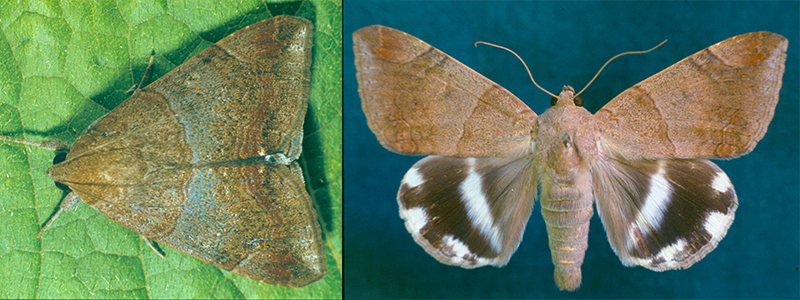
Caster oil moth: at rest (left) and a preserved specimen with wings outstretched
Tobacco looper (Chrysodeixis argentifera) larvae have 2 pairs of abdominal prolegs. Very small larvae are pale green all over; larger larvae (up to 40mm) are green with white stripes and a darker green line along the middle of their back. Their sides have parallel white lines and sometimes a row of black spots. The moth´s forewings are dark brown with small silver ‘figure eight’ markings. On tobacco looper these markings are fused, whereas on the vegetable looper they are separated.
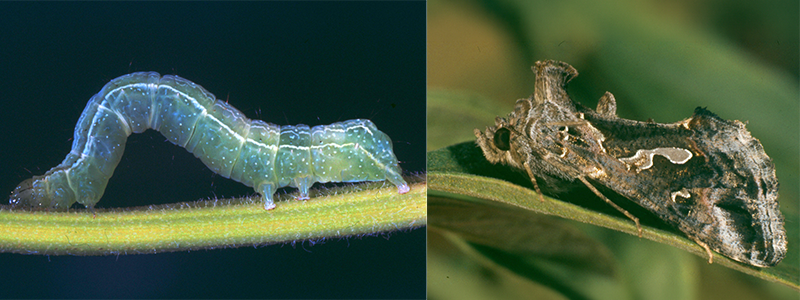
Tabacco looper larva and moth (at rest)
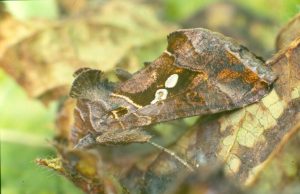
Vegetable looper moth
Vegetable looper (Chrysodeixis eriosoma), also known as green looper, has two pairs of abdominal prolegs. Very small larvae are pale green all over; larger larvae (up to 40mm) are green with white stripes. The moth´s forewings are dark brown with small separated silver ‘figure eight’ dots. Males have long, orange hair-like scales on either side of the abdomen. It occurs throughout northern and eastern Australia, as far south as central New South Wales. Larvae are primarily foliage feeders in soybeans but will attack the flowers and developing pods in azuki beans, mungbeans and navy beans. In sub-tropical regions, crops are at greatest risk from mid to late summer, however in the tropics winter-planted ‘summer legumes’ may also be at risk.
Cotton looper (Anomia flava) is a minor pest of cotton. Larvae (up to 40mm) have 3 pairs of abdominal prolegs, are green and may have white stripes running along the body. The pupae are found in rolled up leaves and emerge as brown moths with patterned wings. Forewings are reddish-brown with a darker grey-brown area at the rear of the wing. Eggs are pale blue-green and are usually laid singly.
Bean looper (Mocis alterna) larvae are most commonly found in coastal and subvcoastal regions. They are relatively slender with 2 pairs of abdominal prolegs, and can be cream, charcoal, bright orange or brown. They may have dark stripes along their back and a cream or yellow band along each side; however, pale cream larvae may only have very faint stripes. Moths have a 30-32 mm wingspan and more rounded wings than helicoverpa. Moths are grey or grey-brown with dark bands and markings on all wings.
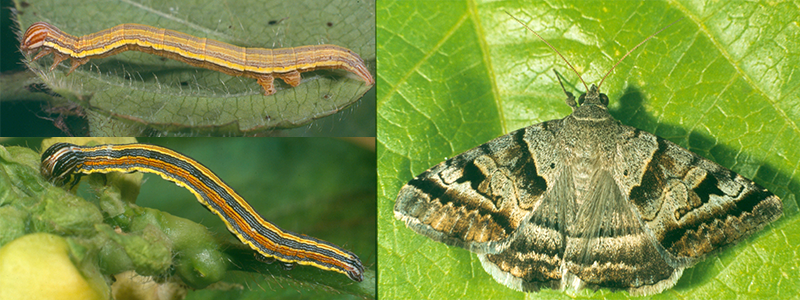
Bean looper: common (top) and striped variants, and moth at rest
Three barred moth (Mocis trifasciata) is a minor pest that is mainly confined to coastal areas. It has been reported in cowpeas in northern Queensland and soybeans at Bundaberg. Larvae have 2 pairs of abdominal prolegs. Medium larvae are brown and prominently striped, often with a darker area down the middle of the back. Large larvae (up to 50mm) are pale brown (fawn) or orange with faint stripes and two broad diffuse grey bands along their back. They have two transverse bands across their thorax (most visible when larvae arch their backs). Moths are larger than other Mocis species, and are brown with two dark bands across each forewing. Their hindwings also have dark bands.
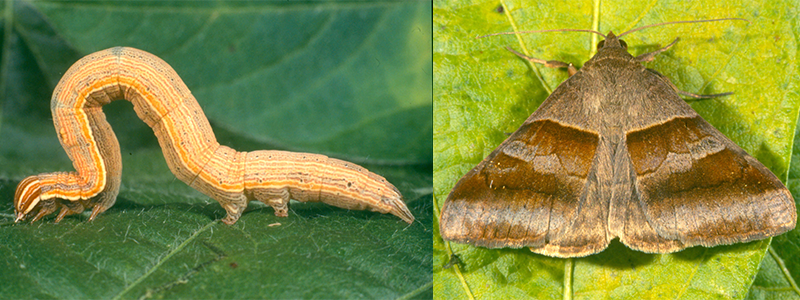
3 barred moth larva and adult
Pantydia spp. (Pantydia sparsa, P. capistrata and P. metaspila – no common names) are sporadic minor pests of soybeans. Medium Pantydia sp. larvae often have 2 pairs of abdominal prolegs and are brown with darker stripes; large larvae (up to 40mm) develop 3 pairs of prolegs and have a mottled appearance with a distinctive pale blaze on their head capsule. Moths are greyish-fawn with variable darker markings; Pantydia metaspila have darker brown forewings with a thin pale band across their outer sector. Hindwings of all species have a broad, dark outer band.
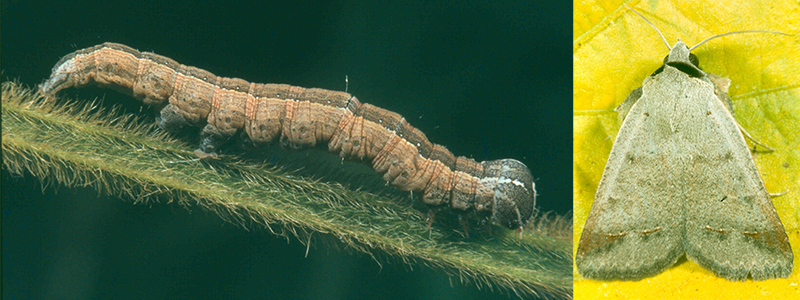
P. capistra larva and moth
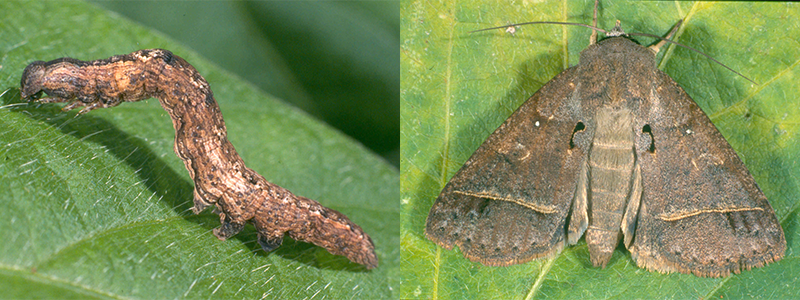
P. metaspila larva and moth
Other loopers occasionally found in field crops include sugarcane looper (Mocis frugalis), Gymnocoelis sp., Twig caterpillar (Scopula perlata) and brown pasture looper (Ciampa arietaria).
Monitoring and thresholds
Loopers feed mostly on leaves, and while they can occur throughout the entire growing season, they normally do not warrant control. However, under some conditions, populations can flare.
Looper damage to leaves tends to be more angular than the rounded holes generated by helicoverpa. Vigorously growing plants will be better able to compensate for flower and pod damage, and damaged leaves will be replaced more quickly.
Monitor crops weekly during the vegetative stage and twice weekly from very early budding onwards until crops are no longer susceptible to attack (late podding). Beat-sheet is the preferred sampling method for looper larvae. Keep an eye out for looper eggs and moths to pinpoint the start of infestations.
In pre-flowering pulses, looper control is warranted if defoliation exceeds (or is likely to exceed 33%). Tolerable defoliation drops to 15-20% once flowering and podding commences. In azuki beans, mungbeans, and navy beans, where flowers and pods can be attacked, the threshold is set at three looper larvae per square metre.
How much can a looper eat?
Control options
Loopers are generally susceptible to all insecticides used for helicoverpa control, with the exception of Gemstar® and Vivus® (NPVs) which only act against helicoverpa. Bt products are far more effective against loopers (particularly on smaller larvae) than against helicoverpa but thorough coverage is required for best results.
Loopers can be attacked by a range of natural enemies of other caterpillars.