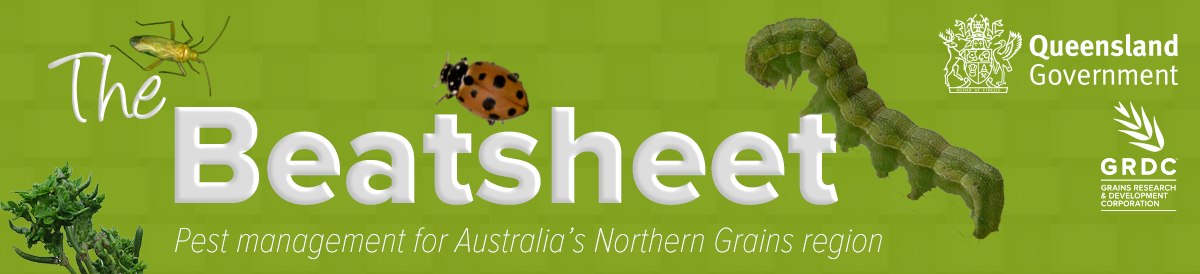
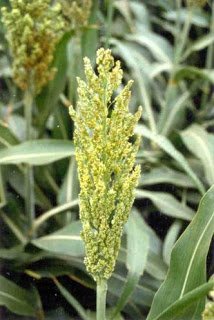
Yellow anthers during flowering (too early to spray).
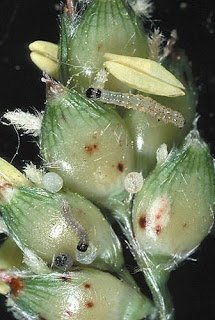
Eggs and newly hatched larvae on sorghum. Photo: D. Ironside
Sorghum growers across the Darling Downs can expect to see an influx of the corn earworm, Helicoverpa armigera, in their flowering sorghum crops over the next few weeks. Growers are well equipped to deal with the problem in an environmentally friendly way.
Moths are active and wanting to lay eggs on susceptible crops, and sorghum crops putting up heads are highly attractive – just what this insect pest loves. The majority of eggs are laid in a narrow window, between emergence of the head from the boot leaf and the commencement of flowering (yellow anthers). This results in highly synchronous development of larvae in a crop – larvae of uniform age in the crop.
It is important that growers check their crops because in many cases feeding by corn earworm is likely to cause economic loss. One larva is estimated to consume 2.4 g of sorghum. Larvae up to 13 mm in length feed mostly on anthers and do not affect yield.
The table below provides examples of crop loss for different larval densities.
Table: The value of crop loss caused by corn earworm larvae in grain sorghum, for a range of larval densities and grain prices and based on 10 heads/metre of row on 1 metre row spacing.
*Based on estimated consumption of 2.4 g per larva.
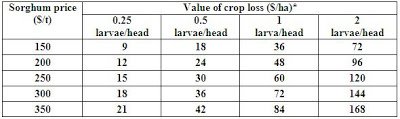
The current high value of grain sorghum (over $300 per tonne) means that it is economic to control larvae at lower numbers (density) than growers may have sprayed previously when grain value was lower.
The economic threshold (i.e. the number of larvae per head where the cost of control is equal to the value of the grain saved) can be calculated using the formula:
No. larvae/head = (C x R) ÷ (V x N x 2.4)
where
C = cost of control ($/ha)
R = row spacing (cm)
V = value of crop ($/tonne)
N = number of heads/metre of row
2.4 = weight of sorghum (grams) lost per larva.
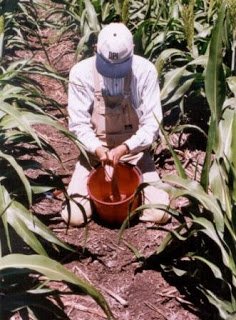
Count the number of larvae dislodged from 30 heads to arrive at a control decision. Obtain 5 consecutive heads at the brown anther stage from at least 6 locations in a field, each location preferably more than 50 m apart. Use the palms of your hands to spin each of the heads into the bucket. Pour the contents of the bucket onto a beat sheet or tray and count the number of larvae in each size class
very small (VS=less than 3 mm in length)
small (S=3–7 mm)
small-medium (SM=7-13 mm)
medium-large (ML=13-21 mm)
large (L=greater than 21 mm).
Control
Effective larval control can be achieved with the use of commercially available nucleopolyhedrovirus or NPV sprays, sold as either Vivus Max® (succeeding Vivus Gold®) or Gemstar®.
NPV is dynamite against corn earworm larvae in sorghum and has the bonus of being a natural disease of the pest, so that spraying only kills the pest and not other beneficial insects and spiders in the crop.
Gemstar® and Vivus Gold® have both been registered for use on sorghum at 375 mL/ha. Lower rates (250-300 mL/ha) have been used successfully by many growers.
Please be aware that Vivus Max® now replaces Vivus Gold®. It is a more concentrated product (2.5 x) and has a registered rate of 150 mL/ha in sorghum (equivalent to 375 mL/ha of Vivus Gold®).
Research into the use of NPV sprays has shown several key points that growers and consultants should remember when using NPV.
First, checking is easy and important – it not only tells you whether you have the pest in enough numbers to justify spraying, but it also gives you information on when to time an NPV spray, since it works best when targeted against the very youngest larvae.
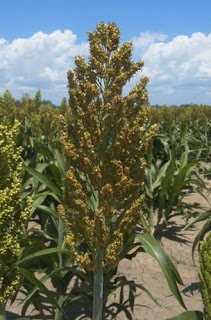
At the end of flowering (heads with brown anthers to base), most larvae will be first or second instar (less than 7 mm in length), and ideal to target with NPV. The best spray timing is when 50% of heads in the field have brown anthers to their base. A further delay of 3 days will help conserve the important larval parasite, Microplitis demolitor.
In crops where there is a large spread of flowering, it is better to spray before 50% of the heads are at the brown anther stage. In these cases, experience has shown secondary infection by NPV can kill a high proportion of the caterpillars that hatch after the NPV application.
NPV should not be used against larvae greater than 13 mm in length.
Good coverage over the plant and especially the sorghum head is critical, since a larva has to actually feed on an NPV particle to become infected with the virus. Sprays should be put on at the time of day that is best suited to getting good coverage, and this will often be in the morning.
Ultra low volume (ULV) sprays of NPV applied by a plane are highly effective in sorghum and allow for large areas to be treated in a relatively short time – this is good news when the pressure is on to treat large areas.
For ULV application, NPV is combined with approved spray oils such as D-C-Tron, Canopy or Biopest oil, to make a minimum spray volume of 3 L/ha.
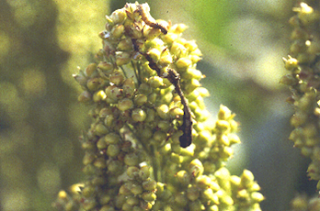
Corn earworm larvae killed by NPV.
Thanks to Anthony Hawes from AgBiotech, manufacturers of one of the NPV products available for helicoverpa control, who alerted us to an error in our original post.
That post listed Vivus Gold® as one of the two NPV products on the market, the other being Gemstar®.
In fact, Vivus Gold® has now been replaced by Vivus Max® which has a new registered rate for grain sorghum.
The original post has now been corrected in the light of this information and we’ve provided links to the labels of both NPV products, Gemstar® and Vivus Max®.
Some of the early flowering sorghum crops inspected on Monday 26 November indicated moderate to high egglay by corn earworm, and plenty of newly emerged moths sheltering in crops. While there will be some dilution of moths across the large area of grain sorghum about to come into head, there are sufficient indications that careful monitoring will be essential to ensure proper timing of NPV sprays to control corn earworm.