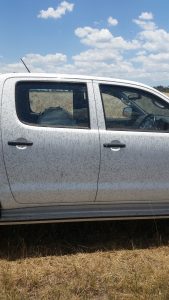
Rutherglen bugs can occur in large numbers
Rutherglen bug (RGB; Nysius vinitor) is a sporadic pest that can migrate into crops in very large numbers in favourable seasons. RGB is widespread, while a related species, grey cluster bug (Nysius clevelandensis) is only a pest in north-eastern Australia. Both species breed on a wide range of native plants and weeds, and populations build up in inland areas when winter/spring rainfall promotes growth of host vegetation. In spring, as these hosts dry off, large numbers of adults can migrate on storm fronts into eastern cropping areas.
On this page:
- Description and lifecycle
- Host plants
- Damage
- Monitoring and thresholds
- Management
- Further information
Description and lifecycle
Adults are a mottled grey-brown-black, about 3–4 mm long with clear wings folded flat over their back. Under magnification, RGB look smooth, while grey cluster bug appears hairy. Adults are generally similar in appearance to mirids, brown smudge bugs and broken-back bugs.
Nymphs are wingless with a reddish-brown, pear-shaped body. They are sometimes confused with aphids, although RGB nymphs move much more quickly. Later instar nymphs are browner and have visible wing buds.
RGB can cycle through 8 generations a year. Females lay up to 400 elongate eggs, about 2mm in length. Eggs are white when laid, reddening as the nymph develops inside. Eggs hatch in 5-10 days (shorter in warmer temperatures) and the nymphs will take 3-4 weeks to develop from 1st instar to adult. Adults live up to 4 weeks.
Nymphs that develop in the crop are generally only seen in maturing crops as eggs are not usually laid until the reproductive phase. For example, in sorghum, RGB females lay eggs in the heads once they have fed on protein in the developing grain. Heavy infestations of nymphs will move up and down on the plant, feeding on both the leaves, stem and in the seed heads, but don’t tend to move between plants. In canola, RGB adults move into the crop during flowering – podding, and eggs are laid into soil, trash, and around the base of the plant.
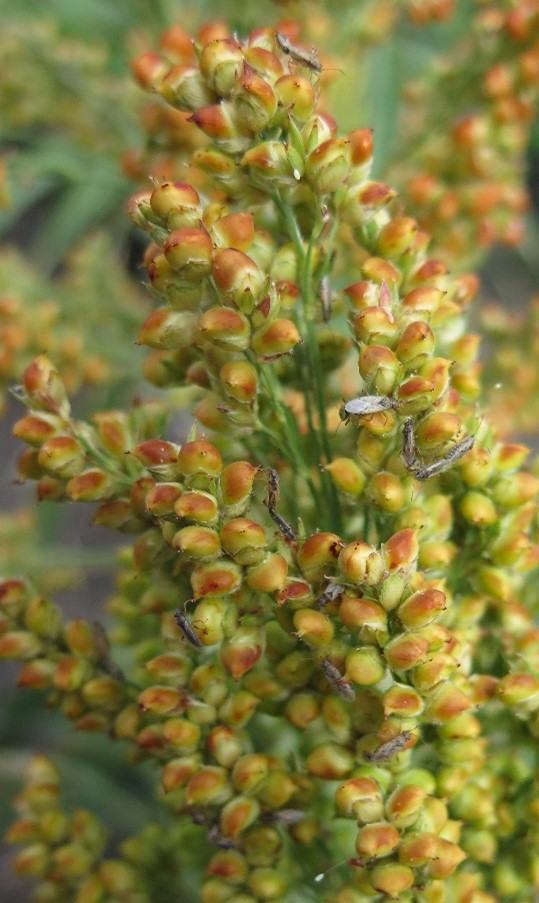
Adults on a sorghum head
Host plants
These bugs have a wide host range, including many weed species. Crops most commonly affected include sunflower, sorghum, canola and safflower. In years of heavy infestations, they can also be found in other crops, including wheat and legumes.
In most years RGB breed on weeds in cropping areas, moving to available crops or weeds when hosts die off. In seasons when RGB is a major pest, the population is usually dominated by migrants from inland breeding. In some instances, crops are invaded by large numbers of RGB nymphs walking out of weedy fallows or maturing neighbouring crops.
Damage
Infestation during grain set and grain fill reduces yield, oil content and oil quality, and seed germination rates. Under wet conditions, fungal and bacterial infections further degrade RGB-damaged grain, infecting through feeding wounds on the seed.
Large numbers of RGB can also affect seedling establishment, simply by weight of numbers feeding on the emerging seedlings.
Sorghum
Sorghum is vulnerable to RGB feeding from flowering to physical maturity. RGB feed directly on developing and filling grain, which not only reduces grain weight, but allows entry of pathogens that further deteriorate the grain. Very early damage looks very much like midge damage.
Sorghum crops infested during flowering will fail to set seed, and infestations during grain filling (milky dough to milky-hard) will result in seed covered in small, dark feeding wounds. These seeds are lighter in weight with poor germination. No yield loss occurs from direct feeding by RGB once grain reaches hard dough.
Very small nymphs cannot damage seed, but larger nymphs (3rd-5th instar) can cause damage. Nymphs do not appear to move from plant to plant, so uninfested heads near heavily infested ones will not automatically be infested.
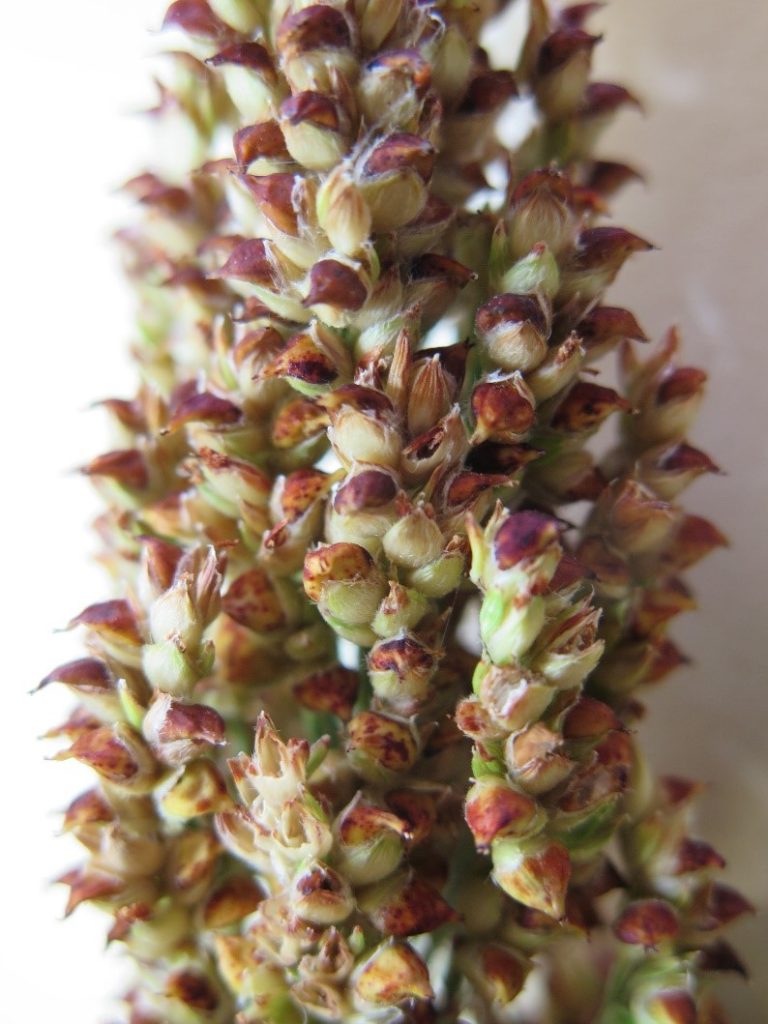
Seed spotting in sorghum
Sunflower
In sunflower, feeding on developing seeds causes both yield loss and a loss of oil content and quality. There are two critical periods during which RGB control may be necessary to prevent crop loss:
- Budding: bugs congregate on the upper stem and bud. Bug feeding on the stem behind the head may cause the stem to wither and the bud droop. These heads do not continue to develop and set seed normally.
- Flowering and seed fill: eggs are laid in the florets when they open, and nymphs emerge in about a week and start feeding on developing seeds.
Adult numbers are often minor in comparison with the size of the population once nymphs start to emerge. Preventing the subsequent population of nymphs is the key driver of RGB control prior to petal drop.
Canola
Both adults and nymphs can potentially decrease yield, oil content and oil quality in canola, particularly if moisture is limited. There may also be edge effects in other crops as large numbers of RGB nymphs move out of canola as it dries down into neighbouring paddocks.
Other crops
In migration years, RGB, may also be found in other crops:
- In mungbean, short infestations of RGB will not usually impact yield or quality, but high densities (>50/plant) may reduce seed quality.
- In cotton, even large numbers of RGB will not damage squares or developing seeds/lint, however they may impact cotton seedlings.
Monitoring and thresholds
Monitor by beating heads into a bucket or tray. In sunflower and other oilseeds, sample from budding onwards. In sorghum, sample from head emergence to physiological maturity (black layer).
RGB populations are often patchy, as they produce an aggregation pheromone, so ensure sufficient samples have been taken to reflect field levels. Also check paddocks for edge effects, particularly if other host crops are maturing or being harvested nearby, as nymphs can walk in from adjacent crops in large numbers.
Sorghum
Monitor for RGB in sorghum crops from booting to milky dough. Infestations are typically initiated by movement of adults into the crop (often with winds associated with storms), so the youngest heads in the crop are at greatest risk of yield loss from prolonged RGB infestation.
RGB sampling can be done at the same time as checking for helicoverpa. Shake the sorghum head into a bucket and count the number of RGB present. Repeat for at least 10 heads from across the field and average the RGB count. RGB infestations can vary greatly between heads. Their clumped distribution means that you will find heads with no, or very few RGB and others with hundreds. Large populations of adults and nymphs are usually seen in heads that are starting to colour, through to harvest.
Sorghum thresholds for RGB are based on crop stage. If the crop has predominantly adults present, the economic threshold is:
- Flowering – Milky dough: more than 20 bugs per head
- Soft dough: more than 20-25 bugs per head
- Hard dough – physiological maturity: RGB have no impact on yield.
These preliminary thresholds provide a broad guide for a range of sorghum prices. To work out a threshold for your specific situation, use a potential yield loss of 20% for 20 bugs per head at flowering. For example, at a sorghum price of $200/t, a 20% yield loss would result in a loss of $40/ha, so it would be an economic proposition to treat the infestation.
If adult numbers are below threshold but nymph numbers above threshold, then treatment is warranted, but can be delayed if nymphs are small. This may allow time for the crop to reach physiological maturity.
Also consider the potential for large populations to cause harvest and delivery issues (clogging, excess moisture, delivery of live insects).
Sunflowers
Thresholds in early (spring) sunflowers are low, not because of the direct damage the adults are causing, but in order to minimise the subsequent nymphs feeding on the developing seed.
Thresholds for late sunflowers are higher, reflecting the lower potential for large increases in the size of the population. From about February on, RGB stop laying eggs and start to go into a reproductive diapause (resting stage) through winter.
Note that reinfestation is a real possibility, with continuing influxes of RGB into crops through November – January. It is likely that spring crops will require multiple sprays to keep populations below threshold and prevent the build-up of large populations of nymphs through the grain filling stage. Being very clear on what critical stages need to be protected enables better targeting of RGB populations.
Early sunflower crop thresholds (spring):
- Budding: 10 bugs per head
- Flowering – seed fill: 20-25 bugs per head
Late sunflower crop thresholds (January – April):
- Budding: 20-25 RGB per bud
- Flowering – seed fill:50 RGB per head
Canola
RGB infestations in canola stubble pose a risk to neighbouring crops, either through damage to establishing summer crops or contamination of unharvested winter crops. RGB may start moving out of canola crops prior to harvest, so monitoring susceptible summer crops adjacent to both harvested and standing or windrowed canola is suggested.
If large number of nymphs move into adjacent fields with seedling summer crops (e.g. mungbean, soybean, sorghum, maize, cotton) they can cause the seedlings to dehydrate and die from sheer feeding pressure. Movement of RGB into budding sunflowers can also increase the risk of damage along the field edge closest to the canola.
If infestations have a clear edge effect, there is an opportunity to control the RGB in the affected portion of the field only, rather than the whole field. RGB movement out of canola can occur over several weeks, so ongoing monitoring and repeated treatment of problem areas may be required.
RGB may also pose a contamination risk to neighbouring winter cereal crop at harvest by congregating in the heads of plants in proximity to the canola. Where crop edges are infested with RGB at harvest, segregation of the grain from the infested area may be warranted to avoid high levels of live insects in the load.
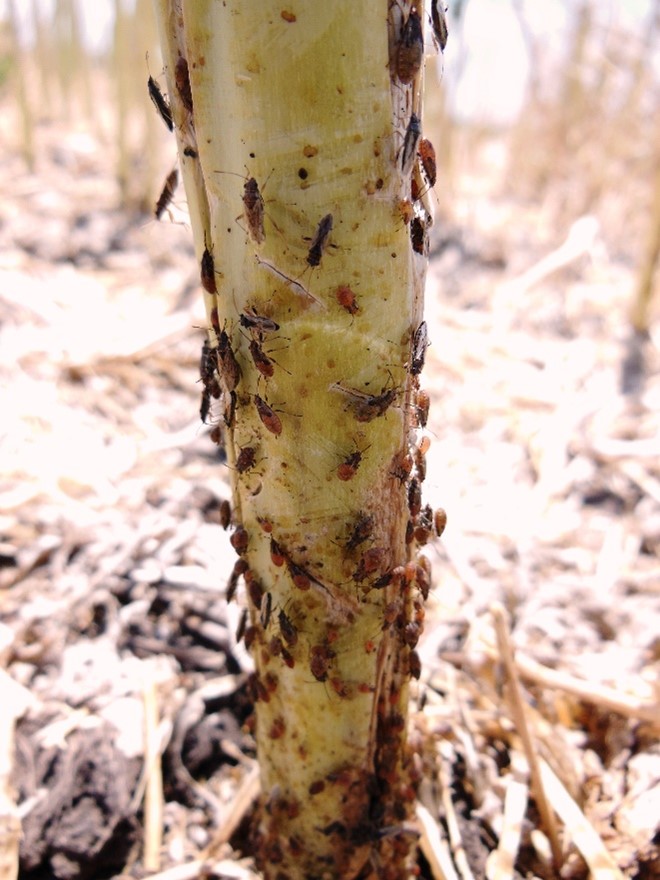
RGB adults and nymphs on canola stubble
Management
Local management will have little impact on RGB in high migration seasons. Managing weeds in and around paddocks prior to sowing can reduce local bug movement onto emerging seedlings.
Egg parasitoids of RGB have been recorded but are unlikely to provide significant control in high population seasons. Records of predation are rare; spiders may play a role in reducing RGB numbers but are also unlikely to have significant impact when RGB populations are high.
Synthetic pyrethroids (SPs) are the main available option for controlling RGB, however they are extremely disruptive to natural enemies, and spraying for RGB may increase the survival of helicoverpa larvae that would have otherwise been controlled by predatory bugs, beetles and parasistoids. If Helicoverpa sp. are present, consider including NPV. Bees are also killed by synthetic pyrethroids. Search the APVMA’s PubCRIS database for products that are currently registered or under permit.
Sorghum
When RGB densities are extreme, it is challenging to get high levels of control. Keep in mind that 90% control of 400 RGB per head will still leave 40 RGB per head, and nymph populations can often be much higher than this.
The challenge of good control is exacerbated by large populations of nymphs that may be moving up and down the plant, and more difficult to contact directly with insecticide. For this reason, insecticides with some residual may be more effective against large, mobile populations of nymphs.
Reinfestation by adults is common and can make repeat applications necessary. Checking treated fields at 2-3 days after spraying will help determine if the treatment was effective. Longer intervals between checks may mean you are unable to distinguish between poor efficacy and reinfestation.
Ploughing a deep furrow between the seedling crop and the source of RGB, or a border spray may be sufficient to prevent ongoing infestation.
When making control decisions, consider:
- pest life stage (nymphs vs adults) present
- the proportion of infested heads
- the distribution of infestation across the field
- the maturity of infested heads
- any variability in maturity within the field
Crops with variable maturity are particularly problematic when making a decision about whether further treatment of the crop to reduce RGB numbers is warranted. Also take into account the potential for large RGB populations to cause harvesting issues if present close to crop maturity.
Sunflower
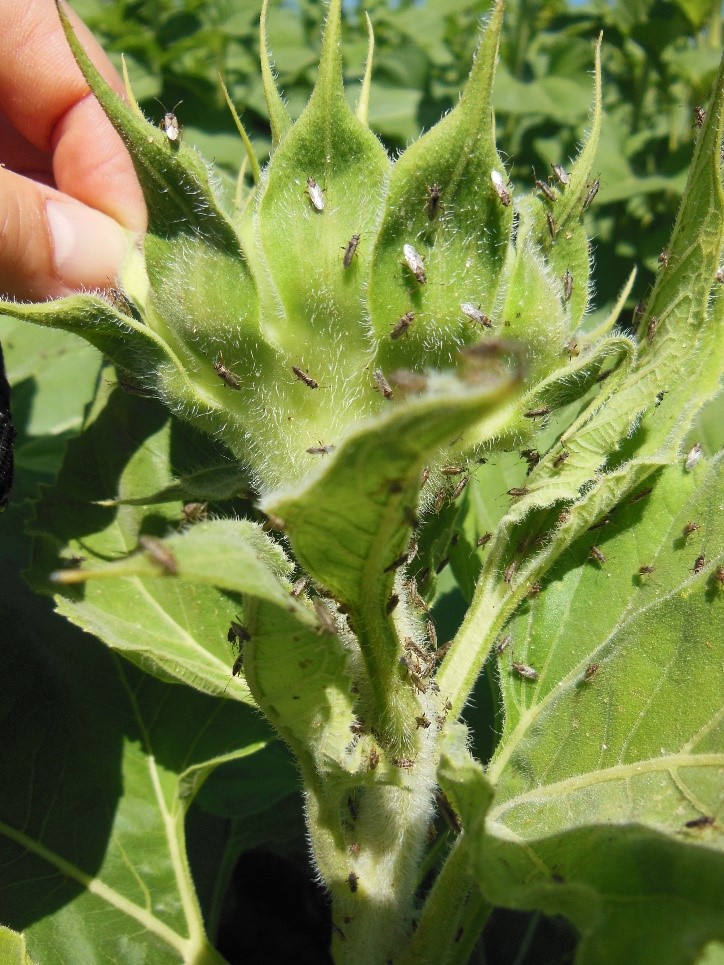
Large numbers of RGB adults congregating on a sunflower bud
There are two critical periods for RGB management in sunflowers:
- RGB adults congregate on the stems behind the head, and bud development can be severely affected by large numbers of RGB. Damage is higher in moisture-stressed crops. Continued influxes of adults into the crop will require ongoing monitoring from budding through to flowering.
- Just prior to petal drop. From about petal drop, when the florets are opening on the face of the flower, RGB will start to lay eggs between the florets. It is critical that RGB adults are controlled before they can lay eggs as the nymph populations will be high, and once the sunflower heads starts to turn down it is extremely difficult to get good control of RGB feeding on the developing seed.
Further information
- Rutherglen bug profile—Cesar PestNotes
- Making decisions about Rutherglen bug in maturing sorghum crops—The Beatsheet
- Rutherglen bug in canola stubble (video)—The Beatsheet
- Registered chemicals database—Australian Pesticides and Veterinary Medicines Authority (APVMA)
- Impact of large numbers of Rutherglen bugs on seedlings (video)—The Beatsheet
Photos by Adam Quade and Melina Miles.