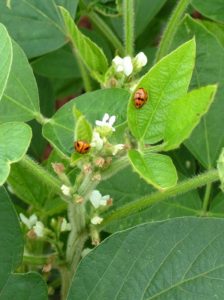
Ladybirds are a key aphid indicator and will find aphids before you do
Predators are usually generalists, feeding on a wide variety of prey, but some feed on only one or a few closely related species. Some or all life stages can be predatory, and they can consume many prey over the course of their development, with prey types usually determined by the predator’s size and mouthparts.
Those with chewing mouth parts (e.g. ladybirds, ground beetles, preying mantids) often consume all of their prey, leaving minimal evidence of their foraging, but those with or piercing-sucking mouthparts (e.g. predatory bugs, lacewing larvae, thrips) which suck out the body contents (sometimes injecting toxins or digestive enzymes) often leave behind an empty shell.
Predators can be transient (e.g. ladybirds) or residential (e.g. predatory mites). Some actively search for prey (e.g. parasitoid wasps), and some lie in wait (e.g. spiders).
| Benefits of predators | Limitations of predators |
|
|
The predators most commonly found in broadacre crops are listed below. Some species can be purchased commercially to augment pest control efforts.
Predatory bugs
Predatory bugs are generally more common in spring and summer and are best monitored visually or by sweep net or beat sheet. They use piercing mouthparts to stab their prey and suck out the body contents.
- Assassin bugs are generalist feeders that prefer caterpillars and small bugs such as mirids, although they will also catch pollinators.
- Big-eyed bug targets insect eggs and small soft-bodied species (e.g. whitefly and mites). It can survive on nectar and honeydew when prey is scarce.
- Brown smudge bug feeds on caterpillar eggs and small insects like aphids and mites.
- Damsel bug feeds on caterpillar eggs, and other small insects like aphids and mites.
- Pirate bug target thrips, mites, insect eggs and aphids, but may also feed on pollen.
- Predatory shield bugs include spined (Oechalia schellenbergii) and glossy (Cermatulus nassalis). Both adults and nymphs predate soft-bodied insects and eggs. Their egg rafts are distinguished from pest species by the short spines present on the rim of each egg.
See the Beatsheet’s image gallery of predatory bugs.
Predatory beetles
Predatory beetles chew their prey, and the larvae look completely different to the adults. Monitor adults visually or by sweep net or beat sheet, and larvae that live in the canopy with a beat sheet. They generally prefer slow moving prey and are abundant in a range of habitats for much of the year.
- Carabid beetles are nocturnal and hunt caterpillars and other slow moving prey. Carab beetle larvae are predaceous but live in the soil.
- Ladybird beetle adults and larvae are important early season predators in most crops. A voracious consumer of aphids, they also eat scale insects, mites, mealybugs, moth eggs and larvae, and whitefly nymphs. Many ladybird species can be found in crops – see the ladybird life stages ID guide (on the factsheets page) and the ladybird lifestages in our image gallery for examples of adults and nymphs. Watch both adult and larval minute two-spotted ladybirds enjoying aphids on the Beatsheet’s ‘video shorties’ page.
- Red and blue beetles eat eggs and small caterpillars, aphids and other slow moving insects.
- Soldier beetle adults will feed on moth larvae and eggs, and other small insects. Their soil dwelling larvae are also predaceous. Thay are also reported to feed on soybeans.
See the Beatsheet’s image gallery of predatory beetles.
Other predators
Ants are generalist predators, eating various small pray, including caterpillar eggs and immature stages of some pests However, they also protect/spread some pests such as aphids and mealybugs, harvesting their honeydew – for honeydew.
Earwig (common brown) is a widespread nocturnal ground-dwelling generalist predator that will attack moth pupae. Other earwig species can be pests of establishing crops.
Hoverfly larvae attack soft bodied insects such as aphids, scale insects, thrips, and caterpillars. Adult hoverfly feed on nectar and pollen. See hoverflies searching for and eating aphids on the Beatsheet’s ‘video shorties’ page.
Lacewings (green) larvae are generalist predators, feeding on thrips, mites, aphids, mealybugs, moth eggs and small caterpillars. Adults feed on nectar and pollen. Larvae camouflage themselves with remnants of dead prey which they place on their backs. See a lacewing larvae eating mealybug in the ‘predators’ area of the Beatsheet’s ‘video shorties’ page.
Lacewings (brown) adults and nymphs are active predators of soft bodied insects and will also feed on moth eggs. Larvae are more elongated than green lacewings and do not camouflage themselves with prey.
Predatory mites are voracious predators of all stages of spider mites. Several predatory mite species can be purchased commercially.
Silverfly larvae are an important predator of aphids; the adults feed on honeydew. Larvae look similar to hoverfly larvae and are distinguished by two ‘horns’ at the rear of the body.
Thrips are generalist predators that fed on very small prey such as other thrips, mites and small eggs; they pierce the prey’s body and suck out the contents. In some crops they are considered a seedling pest, but they can be a significant predator of late season mites.
Spiders (hunting) are generalist feeders that stalk or ambush their prey. They favour mirids, moth larvae and soft bodied insects The most common hunting spider is the lynx spider Spiders are found all year round in most urban and rural habitats.
Spiders (web-building) are generalist predators targeting a range of flying insect pests e.g. moths, mirids, jassids and whitefly. They build large webs between plants and commonly hide under nearby leaves (waiting for insects to become trapped), but many will also eat Helicoverpa larvae. Bushland remnants are important habitats for these spiders in rural landscapes.