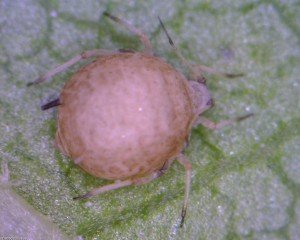
Aphid ‘mummy’. Evidence of parasitoid wasps at work.
A parasite is an organism that lives on or in the body of another organism (the host) during some part of its lifecycle e.g. parasitic mites. However, the parasitic beneficial insects found in grain production systems are usually parasitoids, which (unlike a true parasite) ultimately sterilise, kill and/or consume the host. Because parasitoids spend most of their life cycle developing within their prey, they are less visible than predators, and their impact is often underestimated. They are an important component of IPM because:
- They are host-specific and highly efficient in searching for hosts
- They reduce the number of pests surviving to the next generation
- Pest management with already present parasitoids costs nothing
- They are compatible with other biological control options (diseases and predators)
- At low pest densities, parasitoids can often suppress infestations to below economic thresholds
- Some parasitoids affect host feeding behaviour (e.g. parasitised larvae eat less than healthy ones).
Parasitoids are usually highly specialised or host specific. They tend to be smaller than the host and only the female searches for the host to lay her egg(s) on or in. Immature parasitoids remain on or in the host; sometimes multiple adults may emerge from one pest. Adults are free-living and mobile and often require an alternative food source such a pollen or nectar. All life stages can be highly susceptible to insecticides, but adults are especially vulnerable. Immature parasitoids will usually die if their host is killed.
Most insect parasitoids are wasps or flies. Unlike predators that immediately kill or disable their prey, pests attacked by parasitoids die more slowly. Some hosts are paralysed, while others may continue to feed or even lay eggs before they die.
Parasitoids usually target a specific group or development stage of prey. Lepidopteran (moth) species are targeted at multiple life stages. Some parasitoid species attack one stage but do not emerge from their host until much later. An example is the larval-pupal parasitoid Heteropelma sp. wasp that lays its eggs inside the helicoverpa caterpillar, but the adult wasp does not emerge until after the caterpillar has pupated.
| Target | |
| Aphids | Several wasp species target aphids, including Lysiphlebus testaceipus and Aphidius colemani Dead aphids take on a brown, swollen appearance – called a ‘mummy’. See aphid parasitoids laying eggs and emerging from the aphid mummies on the Beatsheet’s ‘video shorties’ page. |
| Moth eggs | These tiny wasp species lay directly into prey eggs and the adult parasitoid emerges from the egg, killing the host before it hatches, thus preventing crop damage. Parasitised eggs turn black. Wasp species include Trichogramma pretiosum, Trichogrammatoidea bactra, Telenomus sp. |
| Moth larvae | Wasps oviposit into young caterpillars (2nd-3rd instars) or lay eggs on the larvae. Examples include: Netelia producta (orange caterpillar parasite), Heteropelma scaposum (two-toned parasite), Lissopimpla excelsa, and Microplitis demilitor. Fly parasitoids such as Tachinid sp lay eggs on the host. |
| Moth pupae | Wasps locate and penetrate moth pupal chambers, laying an egg in the pupae and feeding off fluids from puncture wound. Species include banded caterpillar parasite wasp (Ichneumon promissorius), which specifically targets Helicoverpa sp. and armyworm, and Brachymeria sp. |
| Shield bug eggs | The egg parasitoid wasp (Trissolcus bassalis) was introduced to Australia. Parasitised eggs turn black. |
| Shield bug adults | Adult and late instar bugs are parasitised by introduced fly (Trichopoda giacomellii) that lays eggs around the bug’s head or thorax region. Maggots burrow into the bug, feeding on the internal organs and killing the host. |
| Whitefly | These wasps target different stages of whitefly development – making them complementary parasitoids. Nymphs parasitised by Encarsia formosa turn black as the wasp develops. Eretmocerus hayati wasps are yellow, and signs of parasitism are more subtle. See the Recognising parasitism in silverleaf whitefly ID guide on the factsheets page for examples of healthy vs parasitised nymphs. |
The speed of parasitoid lifecycles (compared to predators) mean they can be the dominant and most effective natural enemy of some pest insects, but their presence may not be obvious.
| Benefits of parasitoids | Limitations of parasitoids |
|
|
Some parasitoid species can be purchased commercially to augment pest control efforts.