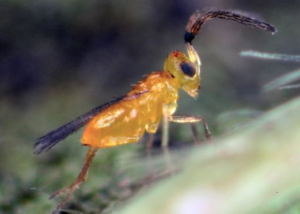
The microscopic natural enemy; Eretmocerus hayati. Image: CSIRO.
Conserving or encouraging naturally-occurring populations, encouraging population increases, or supplementing the natural enemy complex by releasing mass-reared beneficials into the cropping system can help improve the impact of natural enemies.
The degree of effectiveness of beneficials will vary between local situations, crops and regions. When determining whether beneficial releases have a place in your insect pest management strategy, consider:
- Are effective beneficial arthropods for the major pests of your crop currently present in your region at susceptible crop stages?
- Are there any management changes that would support or increase natural enemy populations on your farm?
- Are insecticide applications or other management activities adversely impacting beneficial populations?
- Is an area-wide approach an option for some pests?
Conserving beneficials
Preserve and promote natural enemy activity:
- Consider seed treatment (generally more selective than foliar sprays)
- Regularly monitor for pests and beneficials
- Be aware of thresholds for specific pests
- Tolerate early season damage (if the crop has time to compensate)
- Use selective products (including biological formulations) where practical
- Identify ‘hotspots’ that can be treated instead of the entire field
- Consider novel approaches (e.g. attractants such as Magnet®)
- Consider potential impact of pesticide choice on the beneficial groups present
- Balance longer term economic benefit (e.g. a more expensive spray now may save money over the season by reducing the risk of secondary outbreaks)
Whole-of farm management options include:
- Farmscaping to provide habitat for beneficials within the farming system
- Insectary crops (provide a source of nectar and enhance beneficial activity)
- Preserving native/remnant vegetation as a good habitat arthropod and vertebrate natural enemies
- Consider windbreak composition to offer habitat for beneficial species
- Prevent pesticide drift into areas where beneficials may be residing.
Supplementing beneficial arthropod populations
Ensure the crop is free of potentially harmful residues before releasing beneficials.
Augmentative biocontrol is most common in glasshouses and intensive horticulture, but also has potential for use in some broadacre cropping.
To combat the ‘lag period’ of biological control, releases of low numbers of beneficials should be done early in a pest infestation, and particularly targeting areas where the beneficial species is not already present, to give them time to establish and build population numbers. Examples of inoculative releases in broadacre agriculture include:
- Trichopoda giacomellii, a fly parasitoid that attacks green vegetable bug (GVB) has been released in summer pulse growing regions to suppress GVB numbers.
- Trichogramma pretiosum, a wasp parasitoid (attacking helicoverpa, armyworm, and diamondback moth eggs), has been released widely across eastern Australia and is now well established.
- Eretmocerus hayati releases for silverleaf whitefly control in cotton.
Innundative releases involve high numbers of beneficials with the aim of quickly reducing pest populations (knockdown). Innundative releases have a much higher implementation cost (both insects and labour).
For more information on beneficials available for purchase in Australia or New Zealand, visit goodbugs.org.au