
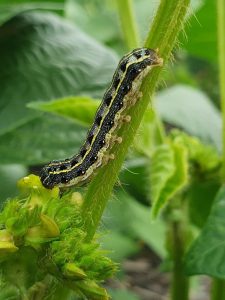
Cluster caterpillar larva consuming mungbean flowers
Over the past few years we have received an increasing number of reports of cluster caterpillar (Spodoptera litura) populations causing significant damage in soybean, mungbean and peanut crops (see A Spodoptera season: Cluster caterpillar outbreak in summer pulses).
In 2025, and again this summer, soybeans in the Burdekin have been heavily defoliated by cluster caterpillar. Agronomists have reported that cluster caterpillar populations have survived insecticide applications targeting helicoverpa, and resultingly built up to very high population densities in crops (e.g. >25 medium-large larvae per m2).
In April 2026, a population of cluster caterpillar from the Burdekin was screened for resistance to chlorantraniliprole and emamectin benzoate by Dr Lisa Bird (New South Wales Department of Primary Industries and Regional Development). This testing revealed very high resistance to chlorantraniliprole (group 28, for example in: Vantacor ®, Shenzi®, Clorantragen®) and very high resistance to emamectin benzoate (group 6, for example in Affirm®, Warlock®, Skope®).
Products with these actives will NOT provide sufficient control of cluster caterpillar to prevent significant crop loss when pest pressure is high.
The use of Group 6 and Group 28 insecticides is widespread in both broadacre and horticultural crops (where cluster caterpillar is often present at low levels). It is likely that repeated applications of these actives to treat helicoverpa and other caterpillar pests has selected for an increased proportion of resistant individuals in the cluster caterpillar population.
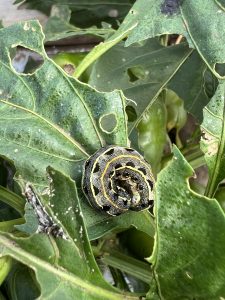
Cluster caterpillar in capsicum
The soybean crops in the Burdekin with resistant cluster caterpillar populations are in close proximity to horticultural production areas and movement of resistant moths between broadacre and horticultural crops is almost certainly occurring.
Genetic studies conducted by NSW DPIRD at Tamworth have confirmed that chlorantraniliprole resistance in cluster caterpillar is recessive. This means that when resistant insects mate with susceptible insects, such as those coming from crops and non-crop vegetation that are not exposed to insecticides, their offspring are susceptible. This natural mixing may help dilute resistance in the population. However, at the frequency of resistance detected in the Burdekin population, it would take many years of dilution before resistance frequency would revert to a level where cluster caterpillar is susceptible again.
Recent studies on Australian cluster caterpillar populations have shown that cross resistance within the Group 28 is highly likely, which means that other Group 28 actives, e.g. tetraniliprole, cyantraniliprole and flubendiamide will also have reduced efficacy against the resistant cluster caterpillar population.
In contrast, resistance to Group 6 insecticides (e.g. emamectin benzoate), recently isolated by NSWDPIRD at Tamworth, was found to be strongly dominant, so even if resistant moths mate with susceptible ones, the offspring will still be resistant. Because of this, resistance to Group 6 insecticides cannot be diluted effectively through mating, making it much harder to manage once it appears. If the exposure of cluster caterpillar to emamectin benzoate continues, we can expect the level of resistance to increase rapidly. It is worth noting that resistance to Group 6 is not the result of cross-resistance to Group 28, it has developed independently.
There is no formal resistance monitoring program in place for cluster caterpillar, so we do not know how widespread this resistance is; whether there are other growing regions in Queensland where similar selection pressure has resulted in the emergence of resistance, or movement of resistant moths between regions has occurred.
However, Group 28 and Group 6 insecticide resistance in cluster caterpillar was detected in populations from Broome and Carnarvon in Western Australia in 2023 following reports of uncontrollable infestations in horticultural crops. Further investigations of populations from a number of production regions in WA detected resistance to carbamates (Group 1A), organophosphates, and synthetic pyrethroids (Group 3A) (see Take action to prevent rise in cluster caterpillar insecticide resistance). What this experience shows is that cluster caterpillar has the capacity to develop resistance to a wide range of mode of action insecticides if selection pressure is sufficiently high. This has been the trajectory in Asia, where the pest is resistant to almost all modes of action.
Where to from here?
The management of further insecticide resistance in cluster caterpillar will depend on the implementation of strategies that reduce the repeated exposure of this pest to each mode of action.
Initially, this will be very challenging as the efficacy of products like Vantacor® and Affirm® has resulted in a high level of reliance on them for the management of key pests like Helicoverpa spp. (heliothis). Additionally, these modern products demonstrate benefits in terms of their selectivity (i.e. ‘softness’ on natural enemies), compared with carbamates and synthetic pyrethroids, which are highly disruptive to natural enemy populations.
Each time another caterpillar pest is targeted with a Group 28 and/or Group 6 product, this increases the selection pressure for cluster caterpillar, if they are present in the crop.
Actives other than Group 28 and Group 6 listed in the table below are i) registered for use in summer pulses, and ii) likely to have some efficacy against cluster caterpillar, based on industry experience and registrations of the same actives for S. litura in horticulture. There have been no recent controlled in-field evaluations of the efficacy of these insecticide options in summer pulses, but such information would undoubtedly increase confidence in their use. Note that this list has been generated for Queensland producers; registration may vary by location – always check the product label.
| Active | MOA group | Tradename examples3 | Summer pulse registrations/permits | Target pests on label | Registered/permitted for cluster caterpillar in summer pulses |
| Bacillus thuringiensis (Bt)1 | 11A | Dipel SC | soybean, mungbean, adzuki, navy, winter pulses and oilseeds | armyworm (Spodoptera spp), helicoverpa, Plutella, Pieris, Chrysodeixis, Ectropis, soybean looper, tobacco looper) | ü |
| Indoxacarb2 | 22 | Steward, ADAMA Indoxacarb 150 | soybean, mungbean, adzuki beans | helicoverpa, soybean looper, Monolepta (soybean only), mirid complex | û |
| Spinetoram2 | 5 | Success Neo | Pulses (soybean, mungbean, navy bean, adzucki etc) | helicoverpa, loopers, soybean looper | û |
| Spinosad | 5 | Nufarm spinosad 480 | Pulses (soybean, mungbean, navy bean, adzucki etc) | helicoverpa, loopers, soybean looper | û |
| Methomyl2 | 1A | Electra, Nudrin | soybean, mungbean, peanuts | helicoverpa, green vegetable bug, bean pod borer, loopers | û |
| Thiodicarb | 1A | Showdown 375 | soybean, mungbean, navy beans, pigeon peas | helicoverpa | û |
| Synthetic pyrethroids2: alphacypermethrin, deltamethrin, cypermethrin | 3A | AlphaScud, Imitrade DeltaDuo | soybean, mungbean, navy bean, | helicoverpa, green vegetable bug | û |
1 must target very small to small larvae only
2 these actives are registered for use against cluster caterpillar in horticultural crops
3 trade names provided as examples only and are not an exhaustive list.
A note of caution: Helicoverpa armigera is already moderately resistant to Group 1A and highly resistant to Group 3A products. Using products from these groups runs the risk of flaring helicoverpa (and other pests) when natural enemies are killed and thus increasing selection pressure for these products.
Go soft early
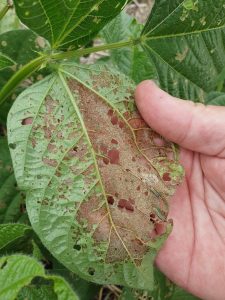
Larvae tend to remain aggregated after hatching from an egg mass (hence the name ‘cluster’), creating noticeable localised damage. Here young larvae have ‘windowed’ a mungbean leaf (a couple are still visible bottom right)
One strategy for managing both helicoverpa and cluster caterpillar in vegetative soybeans is to revisit the “go soft early” approach that was recommended before chlorantraniliprole and emamectin benzoate were available for use in summer pulse crops. This approach, advocated by Hugh Brier, promoted the use of Dipel (Bt) and Vivus Armigen (Helicoverpa NPV) for the control of cluster caterpillar, loopers and helicoverpa in vegetative crops. Bt is effective against several caterpillar pests – particularly small cluster caterpillars, small helicoverpa, and various sized loopers. Vivus, on the other hand, selectively targets helicoverpa. These biopesticides are effective enough against caterpillar populations that are at or just above threshold to reduce the risk of ongoing crop defoliation. To detect small larvae and implement timely application of biopesticides (if warranted) it is recommended that vegetative crops are scouted twice a week.
Going forward, cluster caterpillar in summer pulses is going to prove challenging. We encourage agronomists to record and report any issues of spray failure, particularly in regions outside of northern Queensland. Applying the principles of insecticide resistance management may help prevent further resistance evolving.
The fundamentals of insecticide resistance management are:
- As few applications of insecticides as possible – abide by thresholds and avoid prophylactic insecticide use
- Rotate modes of action and avoid consecutive applications of the same mode of action
- Do not spray a field failure with the same mode of action group
For more general information, see the Beatsheet page on insecticide resistance.
Article by Melina Miles, Trevor Volp and Lisa Bird.
Acknowledgements
Screening of cluster caterpillar was undertaken by Dr Lisa Bird (NSW DPIRD at the Tamworth Agricultural Institute), and Dr Duong Nguyen NSW DPIRD at the Elizabeth Macarthur Agricultural Institute). This work is supported by the Cotton Research Development Corporation (CRDC Project ID 11621) and builds on the identification of resistant cluster caterpillar populations in northern Western Australia horticultural regions in 2024-2025 (CRDC Project ID DAN2301).
We are grateful to the agronomists in the Bowen-Burdekin and Darling Downs regions who have reported unusual cluster caterpillar activity and collected material for screening.
It should be noted that Avatar eVo (indoxacarb) and Success Neo (spinetoram) are registered to control S.litura in a range of vegetable crops. This offers the opportunity to rotate modes of action on this pest.