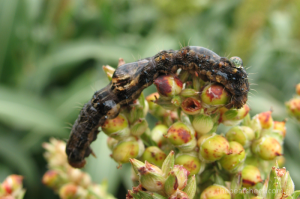
NPV-infected larva
Pathogens are disease-causing microorganisms that infect the pest, usually eventually killing it.
A range of pathogens can infect pest species, but they are usually relatively specific. Some pathogens are available in commercial formations for application in the field, and because of their specificity, their use is compatible with IPM programs.
Viral diseases
Viral diseases are often highly specific. The most commonly available is the caterpillar-specific nuclearpolyhedrosis virus (NPV).
NPVs target the larvae of moth groups, and specific strains are commercially available for fall armyworm and Helicoverpa sp. – these products are most effective on small larva (<7 mm long). Larvae have to eat NPV particles (referred to as inclusion bodies) to become infected. Once ingested, the virus infects the gut cells, spreading to the blood within 24 hours, and then to almost all the tissues in the body. Infected larvae begin weeping liquid and typically climb to the top of the plant before becoming flaccid and disintegrating, releasing millions of infectious virus particles back into the environment. When larval numbers are high, waves of natural infection can develop, resulting in an outbreak.
NPV can kill young larvae within 4 days of ingestion, older larvae within 5 to 7 days, depending on dose and temperature (colder temperatures can prolong the time NPV takes to kill its host to more than 10 days).
When applying NPV:
- Ensure good coverage as the virus requires ingestion
- Target small larvae (less than 7 mm)
- Spray when larvae are actively feeding (between 25°C and 35°C)
NPV can persist in a protected environment such as the soil, but is rapidly killed by exposure to ultraviolet light (sunlight) and high temperatures.
Bacterial diseases
Bacterial cells are not usually utilised directly, but a toxin derived from a bacterium (Bacillus thuringiensis (Bt)) is widely used in agriculture, and is approved for use in organic production systems. Most commercial Bt formulations affect moth larvae, with thorough spray coverage targeting small larvae is needed for best results. Strains are also available for some beetles and mosquito larvae. Bt toxins targeting caterpillars have also been incorporated into some genetically modified crops, dramatically reducing the number of pesticide sprays applied per season.
The major advantage of Bt is that it is essentially non-toxic to people and other animals. Bt integrates well with other natural controls. The insecticide must be ingested to be effective, and is susceptible to degradation by sunlight. Rain or overhead irrigation can also reduce effectiveness by washing Bt from crop foliage.
When applying Bt:
- Ensure good coverage as Bt requires ingestion
- Target small larvae (<5 mm long)
- Spray late in the day to minimise UV breakdown and avoid applying if rain is expected within 24 hours
- Aim for pH of 6.5 to 8.0
Note that while larvae stop feeding soon after ingestion, they do not die for several days. Affected larvae turn black and shrivel up.
Fungal diseases
Fungal diseases are most common in moist environments and may be more prevalent in wetter than average seasons. Common hosts include moth larvae, aphids, mirids, grasshoppers, although they are most effective on small larvae and nymphs.
Fungal spores germinate and hyphae penetrate the insect skin (cuticle), colonise the insect’s body, and may release toxins. Infested insects become covered in hyphae (appear furry) and fruiting bodies develop. The carcass often becomes anchored to the plant surface by the hyphae.
Useful fungal genera include Beauveria, Metarhizium, Hirsutella, Entomophthora, Nomuraea and Verticilium. Some are host species specific.
Unfortunately, consistent mass production of fungi as a biopesticide is difficult, specific temperature and humidity conditions are required for successful insect control, and the formulations have a limited storage life outside the host. However, a few fungal pathogens are being pursued as commercial preparations for application in field situations, and Metarhizium anisopliae is currently sold under the trade name Green Guard® for locust and grasshopper control.
Nematodes
Entomopathogenic nematodes are microscopic worm-like organisms that target soil-dwelling insects. They enter the host body through natural openings and release bacteria that digest the insect. The nematode feeds on the bacteria/insect slurry. When the dead insect’s body ruptures it releases more nematodes.
Treatment with nematodes requires a moist environment and timed application (nematodes are UV sensitive). Commercially produced nematodes (usually (Steinernema or Heterorhabditis spp.) are mostly targeted at backyard pests (fleas, fungus gnats and termites), although there is a species (Steinernema carpocapsae) available for armyworm and cutworm control, and products for the control of slugs and snails.