Pest populations can be reduced or controlled by non-pest organisms (‘natural enemies’) that inhabit the surrounding crop(s), or nearby habitat. An important component of an IPM system, biological control agents have several advantages:
- They are often already present and merely require appropriate management strategies (e.g. using selective insecticides where possible) to improve effectiveness.
- Many are host-specific, allowing targeting of specific pests.
- Some may reduce or prevent population increases in secondary pests.
- Some provide the opportunity to target pests in ‘hard to reach’ places, or attack pests at densities too low to justify other interventions.
- They provide an opportunity to manage pests with tolerance or resistance to chemical products.
Biological control agents include:
- Beneficial arthropods (predators or parasitoids)
- Disease-causing organisms (pathogens).
- Vertebrate insectivores, such as birds and bats.
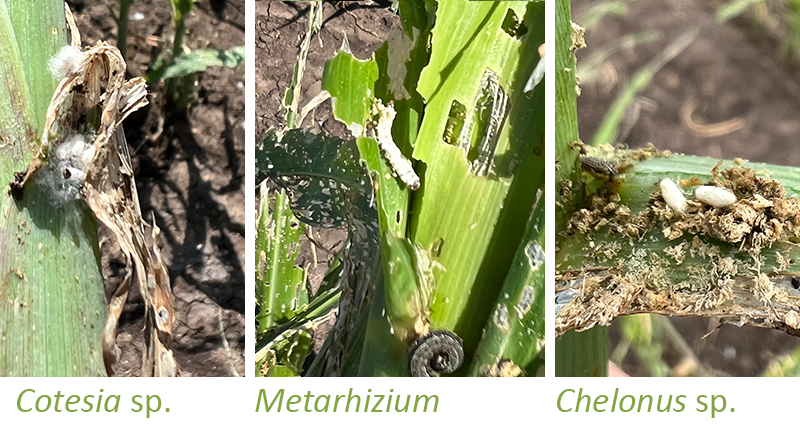
Larval parasitoid cocoons (left). FAW larva turns white after being infected with, and killed by, a fungal pathogen (centre). Egg parasitoid pupae (right), where the wasp larvae emerge from small FAW larvae (killing them in the process) and pupate.
Natural enemies of insect and mite pests are also often referred to as ‘beneficials’, although technically this term has a wider meaning, incorporating other species of use to agriculture, such as pollinators.
We know that the impact of biological control can be significant, however factoring the contribution (or potential contribution) of natural enemies into a management decision can be difficult as that impact is hard to quantify, particularly for generalist species such as predators. While there is some knowledge of prey preferences and consumption in laboratory experiments, there has been very little research to quantify the potential impact on pest populations under field conditions.
It is possible to monitor the presence of some natural enemies, and occasionally threshold decisions will incorporate natural enemy activity (e.g. parasitism of silverleaf whitefly in cotton).
There are a range of management activities that will help conserve or increase natural enemy populations, from providing habitat or avoiding adverse management practices to releasing commercially available insects or pathogens into your fields. Find out more about conserving or augmenting beneficials.
The Good Bugs website provides information on commercial insect, mite and nematode bio-control agents currently available in Australia and New Zealand.