Over the last decade sorghum midge have not caused many headaches for sorghum growers.
However, staggered sorghum plantings mean that sorghum midge are likely to be found building up in numbers in later planted sorghum crops with the potential to cause significant economic loss.
Even if midge are not in high numbers in a crop, the high grain price combined with the low cost of the insecticide of choice (synthetic pyrethroids) means that it is likely that spraying for midge will be a simple economic decision.
In the past the best way to avoid midge damage was to plant as high a midge rated variety as possible as early as possible in the season, and to plant crops well outside overlapping flowering windows of 2-3 weeks within districts. This has not been possible for many growers this season as rain came in a late and staggered fashion. This means that many crops planted over progressive flowering windows are likely to be at risk of midge population build up.
The only way to avoid economic damage is to monitor very closely for midge numbers EVERY DAY during head emergence and flowering and know what your spray threshold for midge is, based on crop value and cost of control, before the midge turn up. This insect pest requires very careful monitoring at exactly the right time of day. By the time you see the adult midge, they are already causing damage.
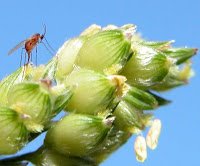
HOW TO COUNT FOR MIDGE
Generally, peak midge activity occurs between 9-11am, and this is the best time to look. However changes in weather can bring midge into a field from surrounding areas at any time of day. Midge numbers can differ widely both within a crop and between plants, even between those right next to each other.
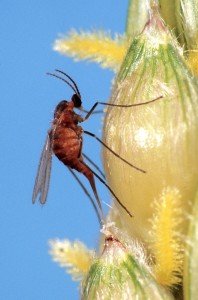
Female sorghum midge laying eggs in sorghum floret.
Sorghum heads are most attractive to midge at mid flower. It is not uncommon to see double or triple the number of midge per panicle on panicles at early-mid flower vs panicles at the end of flowering. At lower midge densities, adult flies will move around and lay almost exclusively on the flowering portion of the panicle.
Midge flies are only 1-2 mm long, so if your eyesight is not what it used to be, then make sure you get someone with good eyes to carefully check each head. It is very easy to underestimate midge numbers if you are not careful.
The easiest way to ‘get your eye in’ is to look at the top half of mid flowering panicles and look for MOVEMENT of the small red flies against a still sorghum panicle looking from side on and slightly above side on one section of the sorghum panicle at a time. Keep your eyes focused over a couple of branches of florets for several seconds at a time to detect female midge walking around the branch or bobbing up and down probing their ovipositor into each floret. Female midge generally walk around quickly when they are ‘on the job’ spending as much time walking around as they do laying eggs.
On windy days you may have to hold each head still and shelter the panicle with your body or a sheet of cardboard (or a large jacket or umbrella?) for 10-20 seconds before scanning each panicle to allow you to more accurately see midge movement. If you can avoid the wind by getting out into the paddock slightly earlier in the morning then your job will be much easier.
Growers should monitor for midge over 10 metres of row in at least 4 different locations in your crop. It may be necessary to spray only one section of crop at a time, or the whole crop accordingly.
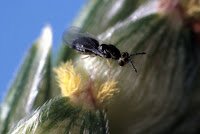
A common experience is that the first midge seen are caught in spiders webs in the field – a sign that midge are active in that particuar field.
As the season progresses, you may also start to see the midge parasitoid, Eupelmus spp (Photo: C. Freebairn). Whilst it can be present in reasonably large numbers, this parasitoid does not occur early enough to prevent midge from causing damage.
MANAGING MIDGE IN SORGHUM
Adult female midge lay their eggs inside sorghum florets where chemicals cannot reach. Insecticides only target the adult midge as they move about the crop and do not kill the eggs or hatched larvae that are already present inside the sorghum florets. While these midge adults only live for one day, they do most of their egg laying (and subsequent damage to the crop) in the morning.It is possible to calculate theoretical yield loss estimates for a particular crop senario (see table). These yield loss estimates are based on extensive field trials by DPI&F that determined the average yield losses per midge per day on different rated midge hybrids

Economic value of midge damage for a range of sorghum midge ratings.
The yield loss estimates in the table assume that spraying results in a 100% kill and that there is no midge damage prior to chemical application. It also assumes that you will receive the same average midge pressures over 4-5 days. In reality research has shown that one well timed insecticide for midge (put on from panicle emergence and before midge even enter the crop) will still only prevent 70-80% damage protection in lower rated sorghum hybrids. In 8 rated hybrids, yield losses can be reduced by over 90% with this spray timing.
If the total cost of applying a synthetic pyrethroid by plane is around $20/ha, we can see that at a grain price of $250-300/t, it is economic to spray low to mid rated hybrids at even 1 midge per panicle and 8+ hybrids at 3 midge per panicle.
Many growers may choose to include a spray for midge with a synthetic pyrethriod in with a virus application for helicoverpa, or may look to clean up midge and rutherglen bug at the same time with one or two well timed pyrethriod applications. In all cases spraying pyrethoids will devastate beneficial insect populations and the implications of this should be included in the decision to spray. Pyrethroid applications on their own are likely to flare helicoverpa and aphid populations.