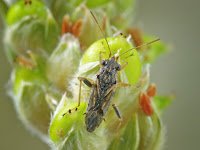
 Rutherglen bug (Nysius vinitor)(RGB) is one of the insect species that arrives in crops in spring in large numbers, usually in association with storm activity. You may also have seen them on your windows and screens (and around the lights) at home in recent days. It is likely that the bugs are moving around in the environment, perhaps even transported from some distance away on storm fronts. You will probably find RGB in all crops and weeds at the moment, not just the winter cereals.
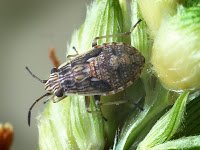
Because RGB are moving so much in the environment, and probably migrating in on storm fronts, we are likely to see ongoing infestations of crops for some time. This means that any decision to control RGB needs to be done with full knowledge that the treated crop may be infested again in a short period of time.
(Photos: RGB adult (top) and RGB late instar nymph (bottom). Keith Power)
Rutherglen bugs in wheat and barley
At this stage in the season, RGB is not going to have any impact on yield in winter cereals. Grain that is hard will not be damaged by this sucking bug.
The main issue with RGB around harvest time is contamination of harvested grain. When RGB are in very large numbers they can cause a number of issues at harvest:
- Live bugs in the sample can result in rejection of a load at the delivery point
- Large numbers of bugs (and bits of bugs) in the grain can elevate grain moisture. This problem is probably worst when RGB are breeding in the crop, and there are large numbers of nymphs – this is unlikely to eventuate in wheat.
- There are no insecticides registered for RGB in winter cereals. If you are controlling armyworm, or helicoverpa (except with NPV) then some of these options will control RGB to some extent. But be very aware of the WHP of any insecticide used this late in the season.
Treating a crop now for RGB is no guarantee that there will not be a reinfestation before harvest
What can you do if you have large numbers of RGB at harvest?
The best approach is to try and limit the number of RGB that end up in the harvested grain. Some of the suggestions for doing this include:
- Harvesting at night
- Fitting screens to the header
- Leave the tarp off the load for as long as possible to allow RGB to escape post harvest
If you are storing grain, RGB will not cause damage to grain in storage, and there is no need to treat grain to kill them. Large numbers of crushed RGB in harvested grain have been identified as tainting the grain with the oily exudates from their scent glands. It is unclear over what period this tainting persists.
What about RGB in other crops?
Seedling and vegetative crops
RGB is primarily a seed-feeding species, and have the capacity to damage crops during grain filling – but we know very little about how much damage in any crop other than sunflower.
In very large numbers, RGB can damage seedling crops purely by weight of numbers feeding on seedlings. In more advanced vegetative crops they will not cause any impact as long as the crop has adequate moisture and is growing actively. Be alert to RGB in sunflower at budding and flowering, and in sorghum from flowering through to soft grain; these infestations may warrant treatment.

RGB in sunflower
Whilst RGB numbers may be high in vegetative sunflower now, it is important to weigh up the decision to spray with the following:
Actively growing plants, with adequate moisture, will not be greatly impacted on by RGB feeding
Reinfestation is a real possibility, and if treating during the vegetative stage, it is likely that insect control in the crop will run to 3 sprays (vegetative, budding and flowering) if RGB pressure remains high and helicoverpa infest the crop as well.
In sunflower there are two critical periods during which RGB can cause significant crop damage:
Budding: bugs congregrate on the upper stem and bud. Bug feeding on the stem behind the head may cause the stem to wither and the bud droop.
Flowering: eggs are laid in the head and nymphs emerge in about a week and start feeding on developing seeds. Adult numbers are often minor in comparison with the size of the population once nymphs start to emerge.
Feeding on developing seeds causes yield loss, and a loss of oil content and quality of grain.
Thresholds for sunflower:
Budding: 10 bugs per head
Flowering: 20-40 bugs per head
If it is necessary to treat at flowering, do so before the heads turn down, otherwise it is difficult to get good contact with the bugs in the flower.
Control considerations in sunflower
Synthetic pyrethroids (SP) are the most effective option for controlling RGB
- If RGB are in large numbers at budding and flowering, but there are a few helicoverpa present, consider an SP/NPV mix. Steward™ (for use in sunflower under permit to control helicoverpa and RGB) will provide, at best, suppression of RGB and will not provide adequate control of a large population.
- The impact of insecticides on bees is an important issue in sunflower, particularly if there are hives nearby. Spraying later in the day, when bees are less active, will reduce the impact on them.