The new economic threshold for Helicoverpa in vegetative soybeans is 8 larvae per sqare metre and replaces the old 33% defoliation threshold. The new threshold is based on field trials conducted by John Rogers (formerly with DPI&F at Kingaroy). These field trials show that approximately 7.5 larvae per square metre can be tolerated with no yield loss, but that severe yield losses can occur once this critical population (the inflection point) is exceeded.
lds were based on the maximum defoliation (33% and widely cited in the scientific literature) that can be tolerated without reducing soybean yield. In John Rogers’ trials, Helicoverpa populations equivalent to the new threshold (8/m2) inflicted significantly less than 33% defoliation. Note that the threshold may be influenced by crop size, with fewer larvae tolerable in very early or very small crops, and more larvae acceptable in larger more vigorous late-vegetative crops.
Immediate intervention with a more robust larvicide may be required against extremely high populations (e.g. > 20/m2). While indoxacarb (Steward®) could be used at this stage, only one application is allowed per field per crop growth cycle, and this product is best saved for later in the season when it is most needed.
loopers and cluster caterpillars which are primarily foliage rather than bud feeders. However, cluster caterpillars are more likely to attack soybean pods than loopers, but not as savagely as Helicoverpa.
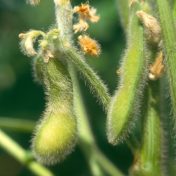
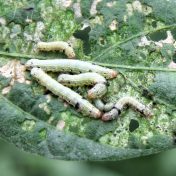
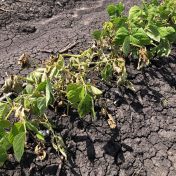
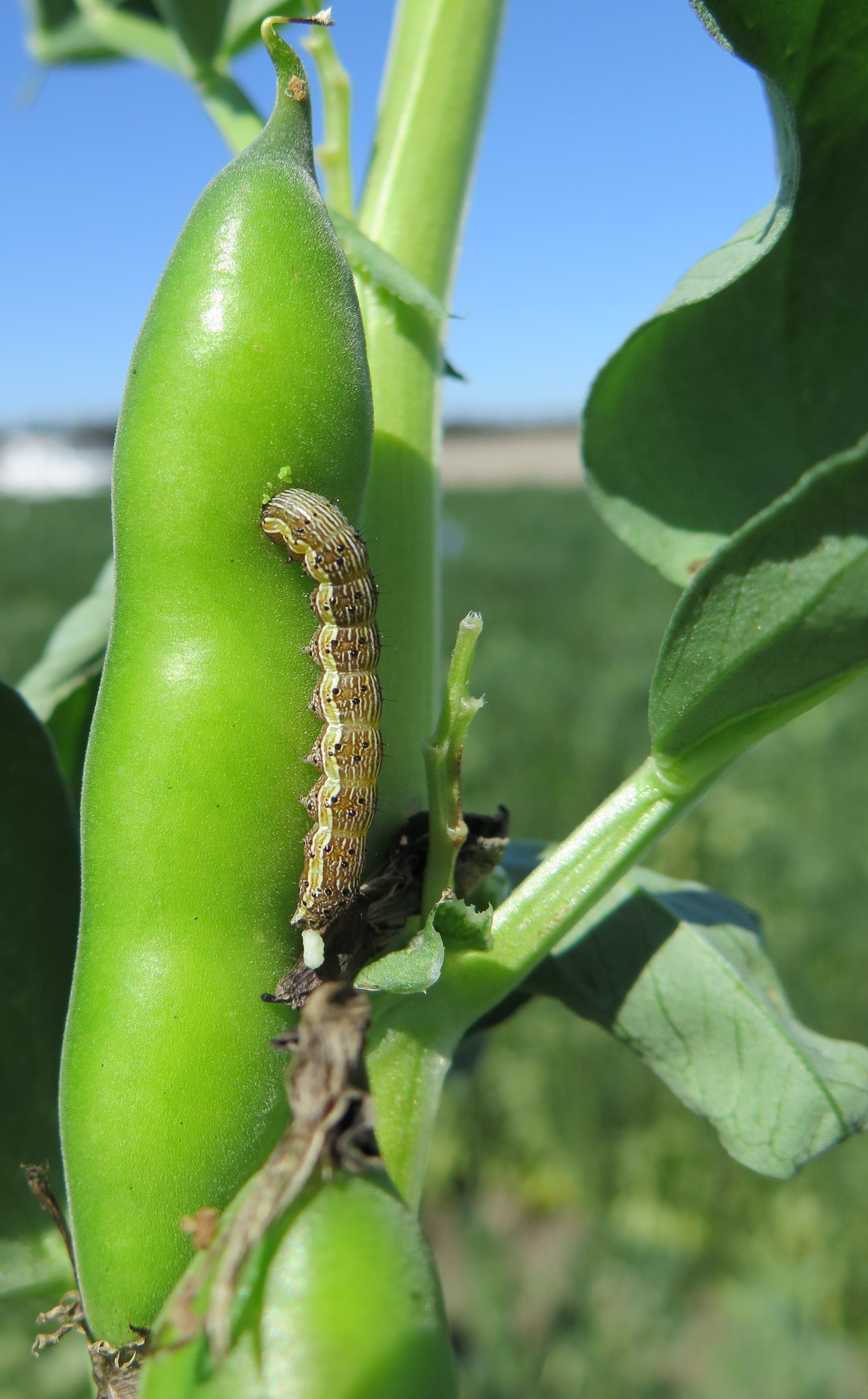
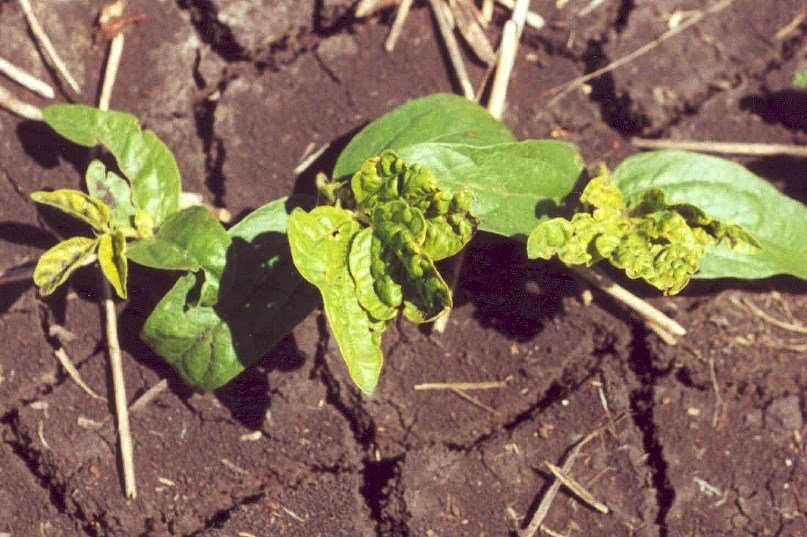
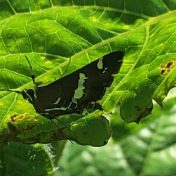
Helicoverpa damage in soybeans
A- vegetative damage
B – damage to terminals results in
C – reduction in pods and yield
Article by Hugh Brier (DPI&F Kingaroy), John Rogers (formerly DPI&F Kingaroy and Kate Charleston (DPI&F Toowoomba)
The new threshold (8 larvae/m2) is based on the maximum number of larvae that can be tolerated before there is an economic reduction in yield. The closeness of the threshold and the inflection point is a measure of the severity of the yield losses that can occur once this critical population is exceeded.
Previous thresho
The reason yield loss occurs below 33% defoliation is because of Helicoverpa’s feeding behaviour – they are not called budworms for nothing. As well as feeding on leaves, they also feed on the soybean plant’s vegetative terminals and auxiliary buds, the latter which are the precursors to floral buds.
Previous vegetative thresholds allowed for vegetative terminal loss (tipping) with 25% terminal loss the cited critical level above which action was required. The new thresholds are below the old terminal-loss guidelines as populations of 8 larvae/m2 destroyed fewer than 25% of terminals in John Rogers’ trials.
The crop’s ability to tolerate 7.5 larvae/m2 during the vegetative stage without yield loss, means that Helicoverpa nucleopolyhedrovirus [NPV] (e.g. VivusMax®) can still be safely used prior to flowering, provided it targets appropriately small larvae (<7 mm long). This is because NPV only has to keep populations below this critical level, rather than achieving ≥90% control that would be required if yield loss commenced as soon as populations exceeded 0/m2.
Until data to the contrary is available, the 33% defoliation vegetative threshold is still valid for
John Rogers’ studies illustrate the link between a pest’s feeding behaviour and its impact on crop yield. The studies also highlight the importance of having ‘species specific’ data, and that a ‘one threshold model fits all’ approach is not always appropriate. Further trials are planned to study the feeding behaviour and damage potential of cluster caterpillars and all the major looper species attacking soybeans. However, such detailed research is likely to take at least 3-4 years to complete. 


When sorghum is valued at $300/tonne, one larva/head could cause $72 crop loss/ha. If the price drops to $150 per tonne, one larva/head causes just $36 crop loss/ha, or 50% less economic damage. This example demonstrates just how important it is to consider each case on its merits, and in particular to consider the cost of control, as it too can vary widely depending on whether aerial or ground spraying is used.
The yield loss estimates in the table assume that spraying results in a 100% kill and that there is no midge damage prior to chemical application. It also assumes that the same average midge pressure persists over 4-5 days. In reality research has shown that one well timed insecticide for midge (put on from panicle emergence and before midge even enter the crop) will still only prevent 70-80% damage protection in lower rated sorghum hybrids. In 8+ rated hybrids, yield losses can be reduced by over 90% with this spray timing.


Based on these figures, and the relatively low cost of controlling armyworm, populations in ripening crops in excess of 1 large larva per square metre will warrant spraying.


Silverleaf whitefly in cotton – an update
Silverleaf whitefly (SLW) is a serious pest of cotton. It reduces yield and quality of cotton due to feeding damage and excretion of honey dew. It is a difficult pest to manage due to its ability to rapidly increase in numbers and the development of resistance to many insecticides.
Resistance testing for the 2007-08 season indicated no alarming results for Admiral® (pyriproxyfen) or Pegasus® (diafenthiuron) in cotton areas. The IRMS guidelines for Admiral® require that only 1 spray may be applied per season. Apart from the cost involved, more then one Admiral® spray has been shown to increase the development of resistance.
As part of the management strategy for whitefly it is important to know what species or biotypes are present as these will significantly impact on the management decision that is required. Refer to past beatsheet articles to read more on identifying the different species and biotypes of whitefly.
In Emerald, a limited number of Pegasus® sprays have been applied for SLW. Pegasus® is best used for early season suppression of SLW at low insect densities or as a late season knock down to prevent honey dew contamination of open bolls.
Very few (if any) Admiral® sprays have been applied so far this season. Admiral® may be applied after 1450 day degrees if SLW numbers reach high densities. Remember that only one Admiral® spray may be applied per season to limit the potential for resistance to develop.
An excellent publication has been produced through the Cotton CRC by Richard Sequeira and Tracey Farrell That outlines thresholds and sampling methods for SLW in cotton in more detail (www.cottoncrc.org.au/files/5743fee2-f978-4a79-a9d1-9b1800e899cf/Whitefly_Management.pdf). This should be referred to when making management decisions for this pest.
In Emerald, there were high levels of natural control of whitefly from the parasitic wasps, Eretmocerus hayati and Encarsia formosa. Parasitism levels of 40% and 75% were recorded in two fields in the Emerald Irrigation Area. In a field at Biloela, parasites were so abundant that the tiny wasps were clearly visible walking around on leaves.
It is likely that the high parasitism levels recorded in Emerald and Biloela are due, in part, to very limited mirid sprays earlier in the season. This has avoided flaring SLW and allowed beneficials to multiply and offer a free service to growers and consultants in controlling whitefly.
Whitefly numbers are reportedly building up at St George/Dirranbandi. DPI&F entomologists will be visiting the area next week to collect samples for resistance monitoring and check parasitism levels.
While whitefly are definitely starting to make their presence felt in cotton fields across Queensland, their presence does not necessarily warrant action. Monitor fields often as whitefly can build up exponentially, identify what species/biotypes are present, use the available thresholds and avoid flaring whitefly by minimising the use of disruptive insecticides and maintaining beneficials in the system.
Article by Zara Ludgate