-
RSS Links
Get The Beat Sheet Newsletter FREE!
Pages
Categories
Archived postings
Meta
Refresher on managing helicoverpa in chickpea
With the approach of spring, helicoverpa start to become active. In CQ, chickpea crops are attractive to moths, and it is timely to revisit some of the key points related to making decisions about control of this pest in crops.In this article, I wanted to discuss a couple of the recommendations which some growers and agronomists have found a bit challenging. Read More
Winter cereal aphids – background to the potential impact of infestations
The most critical issues we face in managing cereal aphids currently is the lack of local knowledge about the likely impact of infestations on yield and quality (the damage thresholds). (http://thebeatsheet-ipmnews.blogspot.com/2008/09/cereal-aphids-in-wheat-and-barley.html). Read More
Posted in Winter cereals Leave a comment
Slaters and other winter cereal establishment pests
In recent days we have received a number of reports of slater activity in winter cereal crops in southern Queensland and northern NSW.
Slaters are not generally regarded as a pest of broad acre agriculture and tend to feed on decaying vegetation and dead animal matter. Overall they perform an important recycling role in the environment however on rare occasions they can also attack seedlings of broad acre crops. Read More
Posted in Winter cereals Leave a comment
New whitefly found!
Detection of Q biotype Bemisia tabaci in Australia
The presence of Q biotype Bemisia tabaci species complex in Australia has been confirmed by Dr Robin Gunning, NSW DPI. Q biotype was collected from vegetables in the Bowen/Burdekin region during late 2008, as well as from cotton in southern Queensland (Goondiwindi) and north-western NSW (Wee Waa) during 2009. It is likely that Q biotype is more widely distributed than just these regions. Read More
Posted in Cotton, whitefly Leave a comment
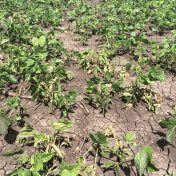
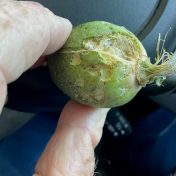
What is eating my soybean pods?
Field crickets
High numbers of field crickets have been reported across the Darling Downs in the last couple of weeks, with some large aggregations of adults attracted to lights at night. Are these crickets doing damage to crops? The answer may well be yes.
Mirids in Mungbeans
Mirids can cause significant crop losses in mungbeans with yield reductions of up to 25-50% common where high mirid populations (eg 10/m2) are left uncontrolled. Mirids can reduce yields by 60 kg/ha for every mirid/m2 of crop.
Mirids can be present in mungbeans at any stage from seedlings to podding. Budding, flowering and early-podding crops are at greatest risk. Low populations of green mirids are often present in vegetative crops but there is no evidence they cause ‘tipping’ of vegetative terminals or have any impact on yield. Mirid populations usually increase with the onset of budding and peak during late podfilll. Generally around 80% of mirids present in flowering/podding crops are nymphs.. Read More
Posted in mirids, mungbeans Leave a comment
Late season pests of pulses and cotton
Go soft early
Go soft early is a basic integrated pest management (IPM) strategy to avoid using non selective pesticides for as long as possible. This approach encourages a build up of predators and parasites to keep early pests in check and buffer the crop against attack later in the season. This strategy is particularly important in soybeans because of the risk of flaring whitefly. With no registered pesticides against whitefly in soybeans the going soft early approach maximises the chances of whitefly parasitism by the recently released wasp Eretmocerus hayati.
Green Vegetable Bugs (GVB) in soybeans
. Read More
Posted in Cotton, Pulses Leave a comment
Soybean Moth causing major damage in soybeans
Soybean moth Aproaerema simplexella is a very common pest of soybeans but is usually only present in very low numbers. This season high numbers of moths and caterpillars were found especially in the Wide Bay Burnett region with some fields sustaining extensive damage. Similar leaf miners attack many horticultural crops, but are species other than A. simplexella. Weed hosts of soybean moth include emu foot (Psoralia tenax)
Identification
The soybean moth is a small narrow winged moth, up to 6 mm long. The forewings are dark brown/grey, each with a white bar across them, and pale brown hind wings. In soybean crops with large infestations, moths can be seen flying up from the foliage when disturbed.

Small elongated eggs are laid on both the top and underside of leaves, generally near leaf veins. Larvae of soybean moth are pale green/grey and grow up to 7 mm (in length).
Soybean moth infestations are favoured by hot, dry weather, with crops under severe moisture stress most at risk. Large populations can cause extensive damage by stripping all leaves from crops and so reduce photosynthesis and grain production.
Monitoring and thresholds
Monitor crops regularly for the early warning signs of rare plague events. Look for numerous small, pale patches (leaf-mining) on the leaves and large numbers of soybean moths in the crop or around lights at night.
DPI&F plans to investigate the effectiveness of a number of pesticides registered in soybeans (against other pests,) as part of GRDC-funded pulse IPM research project DAQ00086. The hope is to identify at least a moderately selective pesticide to preserve soybean moth parasites such as Temclucha sp., a small Ichneumonid wasp (8 mm). This species has been observed in very high numbers in some crops infested with soybean moth.
Article by Kate Charleston and Hugh Brier
The indicative threshold is based on defoliation, with. 33% pre flowering and 15-20% defoliation during early to mid pod-fill.
Control
In most years control is not required but large infestations in the Bundaberg region will need chemical control to prevent total crop loss. Check thoroughly before spraying, as larvae may have already pupated (as black pupae within the webbing) or reached full size (7 mm) and stopped feeding.

There are no specific registrations for the control of soybean moth. However pesticides effective against Helicoverpa (except Helicoverpa virus and Bt), and targeting that pest in soybeans will most likely also give reasonable control of soybean moth.
Other caterpillars that mine and web soybean leaves include soybean leafminer Lithocolletis aglaozona, a much smaller and less abundant species, and legume webspinner Omiodes diemenalis, common in coastal regions, but which is much larger (up to 15 mm) and is bright green. Legume webspinners also web leaves together, rather than mining leaves (feeding inside them).
Similar leaf miners also attack many horticultural crops, but are species other than A. simplexella. Weed hosts of soybean moth include emu foot (Psoralia tenax).
Damage
Larvae initially feed inside leaves (i.e. in leaf mines) and emerge after approximately four days to feed externally, folding and webbing leaves together to form a protective shelter. Infested leaves are often crinkled and pulled together in the middle and this together with webbing of leaf is the most obvious symptom of damage. In low numbers the larvae only cause cosmetic damage. While larvae normally feed on leaves only, extremely high populations will also graze on the surface of pods, after they have denuded the crop of leaves.
Silverleaf whitefly update
There are reports of large infestations of silverleaf whitefly (SLW) from the Narrabri/Moree region. Exponential growth in whitefly numbers coupled with honeydew on leaves indicates that the whitefly are probably SLW and not East Australian native Bemisia or Greenhouse whitefly (GHW).
It is thought that increased host plant availability from a wet winter/spring, warm conditions and a decline in natural enemies due to the use of broad spectrum insecticides has contributed to the high SLW numbers in this more marginal area of occurrence.
DPI&F entomologists will be visiting Narrabri on Thursday, 11 February 2009 and Moree on Friday 13 February 2009 where they will meet with growers and consultants and speak about SLW and the management options that are available.
Cotton fields around St George are at or reaching high densities of SLW. Reports indicate Admiral® has been applied on many fields to suppress SLW populations. Parasitism levels of 50% and 70% were recorded from two fields in the St George area. This should help to keep SLW in check later in the season even if they start to re-infest crops post Admiral® spray.
SLW numbers in Biloela and Theodore are reportedly dropping off. This may be in part due to parasitism levels. Recent testing for insecticide resistance in populations of SLW from Biloela and Theodore show no alarming results for Admiral®. These results were expected due to the minimal use of Admiral® in central Queensland this season.
GHW are in moderate densities in the Norwin region on the Darling Downs. While GHW will produce honeydew it does not normally cause the same problems as SLW which has a wider host range, higher reproductive rate, develops resistance to insecticides rapidly, and is adapted to high temperatures. Where populations are a mix of SLW and GHW, consider treating as if all are SLW.
The report on managing silverleaf whitefly by Richard Sequeira and Tracey Farrell can be accessed through the cotton CRC using the link below: http://www.cottoncrc.org.au/files/5743fee2-f978-4a79-a9d1-9b1800e899cf/Whitefly_Management[1].pdf.
This document outlines sampling, thresholds and management options for SLW. Remember only one spray of Admiral® is allowed per season.
Article by Zara Ludgate
Posted in Cotton, Silverleaf whitefly Leave a comment


Resistance Update on the Road
The Resistance Roadshow visited regional areas during late August and presented the latest resistance monitoring results for a suite of important pests. Presentations covered resistance to conventional insecticides in cotton aphids, mites, silverleaf whitefly and helicoverpa, and helicoverpa resistance to the Bt toxins in Bollgard II. Read More »