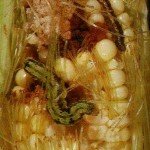
However, in some years, very high pest activity results in more severe cob damage, with larvae often tunnelling into the sides of cobs. In such cases grain samples may contain fungus-affected grains and mycotoxins, causing a downgrade in the quality of harvested grain.
What can you do to prevent these losses?
Over recent years Helicoverpa nucleopolyhedrovirus (NPV) has demonstrated its versatility for corn earworm management. One of the major developments has been the effective application of NPV through overhead irrigation, sometimes referred to as ‘chemigation’.
ViVUS Max is currently the only insecticide registered in Australia for application in overhead irrigation water in a wide range of crops.
By adding NPV to irrigation water, growers can artificially inoculate their crop with NPV and achieve a high level of control of helicoverpa larvae.
The main guidelines for NPV use still apply. These include:
- Good coverage is essential as the product needs to be ingested
- Use in the temperature range 25-35°C when larvae are actively feeding
- NPV is more effective against smaller larvae
- Preferably target larvae less than 7 mm in length, but under ideal conditions larvae up to 13 mm in length will be controlled
- Larvae can take up to 8 days to die
- Spray water pH should be neutral (pH 7.0)
There are additional key points to the successful use of NPV via overhead irrigation.
- Application in overhead irrigation water provides the maximum coverage achievable
- Introduce NPV to the irrigation water at the appropriate rate using chemigation equipment
- If the NPV is diluted in water prior to injection into the irrigation water, ensure that the dilution water is clean and not silty with a pH of 7 or less
- Ensure constant agitation in the premix tank
- Ensure any diluted NPV is used within 10 hours of mixing
- Apply in no more than 10 mm of irrigation water
 For one-pass mobile irrigators such as centre pivots, laterals and travellers (guns), continuously introduce the required amount of ViVUS Max into the irrigation water over the course of irrigation.
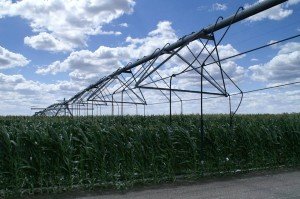 For one-pass mobile irrigators such as centre pivots, laterals and travellers (guns), continuously introduce the required amount of ViVUS Max into the irrigation water over the course of irrigation.
What rates to use? How often?
For ViVUS Max in maize, the registered rate for normal foliar application is 150 mL/ha. When applied in overhead irrigation water, reduced rate repeat applications have been used successfully. An effective prophylactic strategy would be to make the first application at full tassel emergence (50 to 150 mL/ha depending on larval numbers and size) and then low rate (50 to 75 mL/ha) applications every 5 days or so until late blister/early milk stage. A total of 4 applications would use about 250 mL/ha (perhaps more under high pressure). This product cost is around $30/ha and will keep things very clean.
What are the economics of losses to larvae?
A back of the matchbox calculation can be used to give some insight to the damage caused by larvae. An average plant population is 70,000 plants/ha with one cob per plant and one larva per cob. Assume one larva consumes 15 kernels in its lifetime (Note: this value has no validated scientific basis). With an average kernel weight of 4,000 kernels/kg, one larva consumes about 3.8 g. If maize is valued at $300/t, this loss amounts to 262 kg/ha or $79/ha. Based on these rough figures, and assuming a high level of control, there is likely to be an economic benefit from using NPV. Larvae damaging early silks can also reduce pollination, which can result in even greater yield reductions.
Other benefits
As NPV is safe to natural enemies, parasites and predators remain in the crop and keeps working in your favour. This is particularly relevant for the egg parasite Trichogramma which is sometimes very abundant in maize crops. Untreated maize crops can also generate large numbers of helicoverpa moths, so control of larvae in maize can reduce subsequent pressure in nearby crops.
Article by David Murray and Anthony Hawes. Image of lateral move irrigator by Graham Harris.