Brown stink bugs have been reported in some Bollgard® II cotton crops on the Downs. As the season progresses, bug numbers may increase.
Distinguishing ‘brown’ stink bugs from each other.
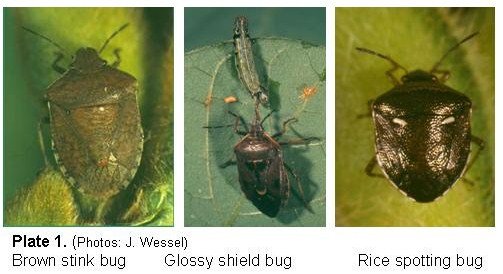
Adults brown stink bugs (Dictyotus caenosus) are shield shaped, matt brown, and smaller than green vegetable bug (GVB), about 7 – 8 mm long (Plate 1). They may be confused with glossy shield bug (Cermatulus nasalis) which is a slightly larger predatory bug, and with rice spotting bug (Eysarcoris distinctus) which is smaller (5 – 6 mm) and has two pale elongated marks on the top (Plate 1).
Brown stink bugs lay pale cream eggs in twin row rafts (Plate 2).
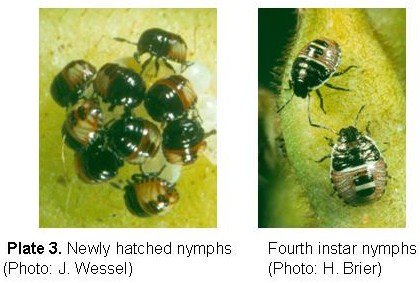
Eggs are similar in shape to GVB eggs, but egg rafts of GVB are seldom in two rows. Newly hatched nymphs are orange with dark markings and a black head (Plate 3). These are indistinguishable from other shield bug nymphs. As they grow they change colour to have a pale brown abdomen and transverse dark and pale markings at the centre of the abdomen (Plate 3, fourth instar nymphs pictured).
What damage can brown stink bug cause?
Brown stink bugs cause damage similar to that caused by GVB or mirids; black spots develop on the bolls, warty growths form inside the boll walls and lint may be discoloured. Bolls up to 20 days old may incur more damage than older bolls due to brown stink bug feeding.
Is there an establishedthreshold for brown stink bug?
No direct assessment has made to determine brown stink bug thresholds. However, brown stink bug damage was compared with GVB and other shield bug damage in a cage trial.
Brown stink bug caused least damage of all the shield bugs, causing just ¼ of the damage caused by GVB. As the GVB threshold is 1 per metre, the brown stink bug threshold would be 4 per metre.
Monitoring for brown stink bug
A beat sheet is the most efficient sampling method for monitoring brown stink bugs. Their distribution in the field is very patchy, just like other shield bugs. Therefore, to obtain a reliable estimate, a thorough check throughout the field is necessary. When a pest insect has a patchy distribution it is important that samples are taken from as many sites as possible across a field. Increasing the number of samples, and ensuring that samples are taken from sites right across the field, will result in the most accurate assessment of pest abundance. If only a small number of samples are taken from just part of the field, you may hit or miss a hotspot and get an unrepresentative count of stink bug numbers in the field.
Managing brown stink bug in cotton.
There are no known specific predators or parasites for this pest. However, spiders and ants may predate on smaller nymphs. Chemical control is the most effective way to manage them. Chemicals registered for GVB should be effective against brown stink bug.
Brown stink bugs in cotton – by Moazzem Khan
Distinguishing ‘brown’ stink bugs from each other.
Adults brown stink bugs (Dictyotus caenosus) are shield shaped, matt brown, and smaller than green vegetable bug (GVB), about 7 – 8 mm long (Plate 1). They may be confused with glossy shield bug (Cermatulus nasalis) which is a slightly larger predatory bug, and with rice spotting bug (Eysarcoris distinctus) which is smaller (5 – 6 mm) and has two pale elongated marks on the top (Plate 1).
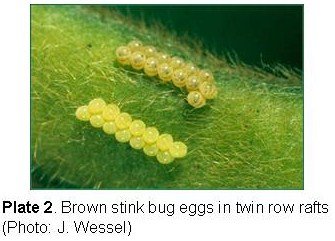
Brown stink bugs lay pale cream eggs in twin row rafts (Plate 2).
Eggs are similar in shape to GVB eggs, but egg rafts of GVB are seldom in two rows. Newly hatched nymphs are orange with dark markings and a black head (Plate 3). These are indistinguishable from other shield bug nymphs. As they grow they change colour to have a pale brown abdomen and transverse dark and pale markings at the centre of the abdomen (Plate 3, fourth instar nymphs pictured).
What damage can brown stink bug cause?
Brown stink bugs cause damage similar to that caused by GVB or mirids; black spots develop on the bolls, warty growths form inside the boll walls and lint may be discoloured. Bolls up to 20 days old may incur more damage than older bolls due to brown stink bug feeding.
Is there an established threshold for brown stink bug?
No direct assessment has made to determine brown stink bug thresholds. However, brown stink bug damage was compared with GVB and other shield bug damage in a cage trial.
Brown stink bug caused least damage of all the shield bugs, causing just ¼ of the damage caused by GVB. As the GVB threshold is 1 per metre, the brown stink bug threshold would be 4 per metre.
Monitoring for brown stink bug
A beat sheet is the most efficient sampling method for monitoring brown stink bugs. Their distribution in the field is very patchy, just like other shield bugs. Therefore, to obtain a reliable estimate, a thorough check throughout the field is necessary. When a pest insect has a patchy distribution it is important that samples are taken from as many sites as possible across a field. Increasing the number of samples, and ensuring that samples are taken from sites right across the field, will result in the most accurate assessment of pest abundance. If only a small number of samples are taken from just part of the field, you may hit or miss a hotspot and get an unrepresentative count of stink bug numbers in the field.
Managing brown stink bug in cotton.
There are no known specific predators or parasites for this pest. However, spiders and ants may predate on smaller nymphs. Chemical control is the most effective way to manage them. Chemicals registered for GVB should be effective against brown stink bug.