 A new guide to calculating economic thresholds available now
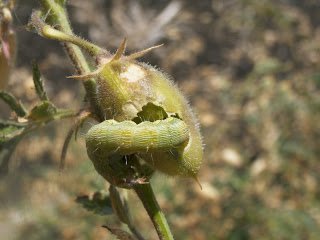
Growers and agronomists are now able to calculate how much yield they will lose if they do not control an infestation of helicoverpa in chickpea. They can calculate the point at which it is economic to control an infestation based on the potential yield loss, their costs of control, the expected grain price and their own preference for benefit:cost.
Being able to calculate the economic thresholds based on an individual grower’s situation is a significant advance on the old recommendations which were fixed at 1-4 larvae per square metre, and did not allow for adjustment when there were changes in grain price or costs of control.
The calculation is now possible following several seasons of research by Melina Miles and Richard Lloyd in Toowoomba, and Paul Grundy and Sherree Short in Biloela. The DPI&F entomologists have worked out that one helicoverpa larva, surviving from hatchling to pupa, will consume 2 grams of chickpea grain. This information is the basis on which potential crop loss ($/ha) is calculated.
The research also examined the impact of spray timing on yield and found that no yield loss occurred when larvae were allowed to feed in vegetative and flowering crops. Yield loss only occurred when larvae fed on developing, filling and maturing Many hours observing larval feeding in the field supported this result. Observations found that larvae of all sizes fed readily on leaves, large larvae did the majority of feeding on pods, and that neither small nor large larvae fed on buds and flowers. However, there are seasons when larval pressure in vegetative and flowering crops may necessitate control.
Grain quality was assessed in both threshold and spray timing trials, and no loss in quality (increase in splits or damaged grain) was seen within the range of densities that it was economic to spray.
In summary, the recommendations for helicoverpa management in chickpea are:
-
- Use a beatsheet to sample helicoverpa in chickpea.
- Exclude very small larvae from threshold calculations – they are difficult to assess accurately in the field – they will be counted as smalls at the next count.
 Adjust the number of small larvae for natural loss from disease, predation etc (30% loss)
-
Calculate potential crop loss ($/ha) using the equation.

- Unless pressure is extreme, delay any control until crops are setting, filling or maturing pods. It may be necessary to apply control during flowering if targeting small larvae that will be medium-large by pod set.
- Details of the research, and calculations of economic thresholds are in the new brochure – get yourself a copy!


This research was supported by GRDC and DPI&F.