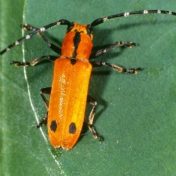
Last week the Australian Pesticides and Veterinary Medicines Authority (APMVA) updated minor use permit PER88226 for the in-furrow application of fipronil to manage lucerne crown borer (Zygrita diva, LCB) in soybeans at planting. Changes include: Extension of expiry date to 30 September 2025 Addition of a re-entry statement and S161 statement Adjustments to the protection statement Moving spray drift to… Read more »
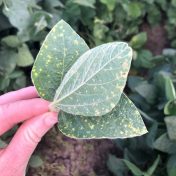
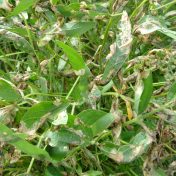
Disease surveys across southern Queensland have revealed a high incidence of Downy mildew in several soybean crops in April 2022. The downy mildew pathogen, Peronospora manshurica, infects crops during periods of rainy, humid weather. Though widespread, the disease is likely to have a minimal impact on yields. The pathogen can survive between soybean crops in infected seeds, on volunteer soybeans or alternative… Read more »
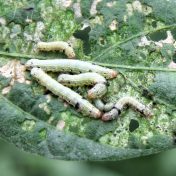
Soybean moths are on the move in the tropics with devastating populations reported in the Ingham region of NQ (see photo). Fuelling the outbreaks was a recent extreme heatwave event which saw temperatures ranging between 29-40 degrees Celsius for 12 straight days. While the heat may have made people lethargic, it greatly hastened the rate of larval development and many… Read more »
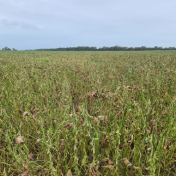
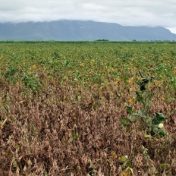
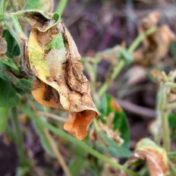
As we enter the business end of the season, we want our soybean crop’s leaves to be a healthy green, as the healthier the leaves, the more the pods fill and the higher the yield. In a drought year, dryland crops turn brown prematurely due to lack of water, but in wet years or in irrigated crops, leaves should not… Read more »
With a range of pest outbreaks recently (including fall armyworm), and the issuing of several new permits in Australia, there has been some confusion as to whether pulse crop references on spray labels and permits in Australia include soybeans. The good news is that the answer is yes it certainly does! Soybeans are listed by the APVMA under Crop Group… Read more »
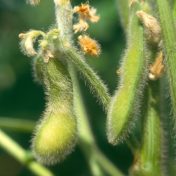
Update (20 April): There are reports that cluster caterpillars are also switching from leaf to pod feeding in maturing crops in the Mackay region, with a report of 5-10 larvae per square metre in many crops. Growers and consultants in all coastal regions are urged to check their crops for late season cluster caterpillars. Reports have just come to hand… Read more »
Since early March 2020, soybean growers in the Burdekin have seen significant damage to their crops. Close inspection of crops found many with soybean stem fly damage as well as leaf spots, and stem and pod lesions. Severely affected plants have suffered complete and rapid leaf defoliation. In many crops, plants did not collapse until the late pod-fill stage, when… Read more »
UPDATE (1 October 2019): High numbers of moths are still being reported in this region. Continue to check soybean crops for this pest. Reports have come in of major soybean moth activity in winter-planted soybeans in the Burdekin and Mackay regions. Some of the outbreaks caught all concerned by surprise, and one report came from a crop barely 10 days… Read more »
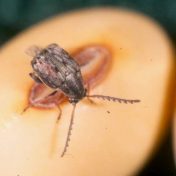
Outbreaks of Bruchidius mackenziei (unofficially called the soybean bruchid) have been reported recently in soybean crops in the South Burnett and North Queensland. The bruchids were detected at harvest and postharvest, their timing matching previous reports of this pest from the Darling Downs and Burnett in 2009/10. Bruchidius mackenziei is a native bruchid that is most likely not a true… Read more »
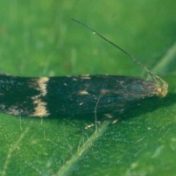
Significant soybean moth flights have been observed recently in some coastal Burnett soybean crops. Little damage has been observed to date, but high numbers of adult moths are an early warning sign of potential severe defoliation. Soybean moth is usually a minor soybean pest but in spasmodic major outbreaks, larval populations can exceed 1,000 per square metre. Identification Soybean moths… Read more »