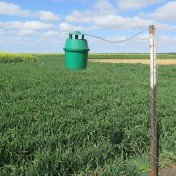
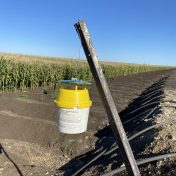
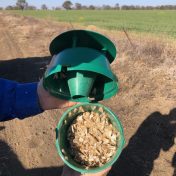
Helicoverpa punctigera pheromone traps around the Maranoa, Western Downs and Central QLD regions are recording above average moth numbers. In particular, long-term sites at Roma and St George have both recorded well above their seven year average for this time of year. Continued migration of H. punctigera through spring is likely, if suitable weather systems occur, and it is likely that… Read more »
The Field Crops Entomology Team at the Queensland Department of Agriculture and Fisheries has recently established a new moth pheromone trapping network to inform the northern grains industry of the seasonal population patterns of key caterpillar pests. A collaborative network of more than 25 growers and agronomists are assisting the monitoring of pheromone traps in 20 locations across 10 regions…. Read more »
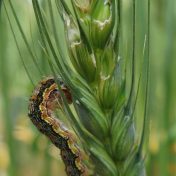
Many regions in Qld and northern NSW are still experiencing an outbreak of Helicoverpa armigera in wheat. Before the last significant outbreak occurred in 2016, it had been many years since anyone had seen such an event, and while there was a smaller outbreak in 2020, it was not on the scale or severity of this year. In many crops… Read more »
Since early 2020, growers and agronomists have been nervous about the prospect of fall armyworm (FAW; Spodoptera frugiperda) invading their crops. So far, the majority of significant and damaging FAW infestations have been recorded from sweet corn, maize, and sorghum crops, with some isolated outbreaks in horticultural crops such as ginger and capsicum. Occurrences in other crops have been a… Read more »
Helicoverpa outbreaks in wheat are relatively rare events. The last big outbreak, in 2016, was the first significant event for several decades, so treating helicoverpa in wheat is not something that many agronomists are familiar with. However, 2020 looks to be a year when helicoverpa infestations in some crops may warrant control. Wet winters are well correlated with outbreaks of… Read more »
The annual Helicoverpa spp. pheromone trapping program for the Northern Grains Region commenced last month. During the first few weeks of trap catches, trap operators have detected flights of both H. punctigera and H. armigera in pheromone traps across the Northern Region. As we have seen in the last six years of our trapping program, H. armigera flights are consistently… Read more »
Each year NSW Department of Primary Industries conducts a Helicoverpa insecticide resistance surveillance program in the major summer cropping regions of NSW and QLD, focussed on detecting Helicoverpa resistance to the insecticides indoxacarb, emamectin benzoate and chlorantraniliprole. The program provides growers and advisors with an early warning system for potential resistance hot-spots in the northern region, and is essential for… Read more »
Every year the Queensland Department of Agriculture and Fisheries runs a Helicoverpa spp. pheromone trapping program for the Northern Grains Region to detect flights of Helicoverpa armigera and Helicoverpa punctigera in important cropping areas. The trap network provides growers and agronomists with a warning system for potential egg-lay in susceptible crops. Although very few crops were planted this season due… Read more »
The yearly Helicoverpa spp. pheromone trapping program for the Northern Grains Region, run by the Queensland Department of Agriculture and Fisheries (DAF), has recently commenced. During the first few weeks of trap catches, trap operators have detected flights of both H. punctigera and H. armigera in pheromone traps across the Northern Region (Table 1). Table 1. Latest Helicoverpa spp. pheromone… Read more »
The 2018 spring Helicoverpa pheromone trapping program for the Northern Grains Region has recently concluded. The program, run by the Queensland Department of Agriculture and Fisheries for the Northern Grain Growing region, forms part of the national Helicoverpa monitoring network jointly run by DAF, cesar, SARDI, and DAFWA. The primary purpose of the trapping network is to detect high moth… Read more »